Support our educational content for free when you buy through links on our site. Learn more

How Can I Make Music for My Song? 🎶 The Ultimate 12-Step Guide (2026)

Ever wondered how your favorite artists turn a simple melody humming in their head into a chart-topping hit? Spoiler alert: it’s not magic—it’s a blend of creativity, technique, and the right tools. Whether you’re a bedroom producer armed with just a laptop or a curious songwriter ready to dive into music production, this guide unpacks everything you need to know to make music for your song from scratch.
Did you know that over 90% of today’s hit songs started as a rough loop or a vocal hum recorded on a phone? We’ll show you how to harness that raw spark and transform it into a polished track ready for streaming platforms. Plus, stick around for insider tips on overcoming writer’s block, choosing the perfect DAW, and even collaborating online like a pro. Ready to turn your ideas into music that moves people? Let’s get started!
Key Takeaways
- Start with a clear song structure to keep your music focused and engaging.
- Choose the right DAW based on your style and workflow—options range from beginner-friendly Soundtrap to pro-level Ableton Live.
- Build your track step-by-step: drums and bass first, then melodies, vocals, and effects.
- Use simple tools and techniques to record clean vocals and instruments, even in a home setup.
- Mix and master carefully to polish your song for streaming platforms like Spotify.
- Leverage online platforms for collaboration, remixing, and promotion to get your music heard worldwide.
Curious about which gear and software pros swear by? Or how to break through creative blocks? Keep reading to unlock all the secrets!
Table of Contents
- ⚡️ Quick Tips and Facts About Making Music for Your Song
- 🎶 The Evolution of Songwriting and Music Production: A Brief History
- 🎛️ Music Production for Beginners: Step-by-Step Masterclass to Craft Your Song
- 1. Understanding Song Structure: The Blueprint of Your Music
- 2. Choosing the Right Digital Audio Workstation (DAW) for Your Style
- 3. Crafting Melodies and Harmonies: Tips from Pro Musicians
- 4. Laying Down the Rhythm: Drums, Beats, and Groove Essentials
- 5. Recording Vocals and Instruments: Techniques for Crystal Clear Sound
- 6. Mixing and Mastering: Polishing Your Song to Perfection
- 🎹 Essential Tools and Gear for Making Music at Home
- 🎧 Popular Software and Plugins to Elevate Your Music Production
- 🧠 Creative Inspiration: How to Overcome Writer’s Block and Spark Ideas
- 💡 Music Theory Basics Every Aspiring Songwriter Should Know
- 🎤 Collaborating with Other Musicians and Producers: Tips for Success
- 📱 Making Music Online: Platforms and Communities to Share Your Work
- 🎵 Remixing and Sampling: Adding a Fresh Twist to Your Song
- 📈 Promoting Your Music: How to Get Your Song Heard by the World
- 🛠️ Troubleshooting Common Challenges in Music Production
- 🎯 Setting Realistic Goals and Tracking Your Progress as a Music Maker
- 📝 Conclusion: Your Journey to Making Music for Your Song Starts Here
- 🔗 Recommended Links for Music Production Resources
- ❓ Frequently Asked Questions About Making Music for Your Song
- 📚 Reference Links and Further Reading
⚡️ Quick Tips and Facts About Making Music for Your Song
- Start with a vibe, not a violin. Before you touch a keyboard, decide the mood (chill, hype, cinematic, lo-fi). A clear emotional target keeps you from drowning in 2,847 synth presets.
- Your phone is already a studio. Apps like Song Maker: Music Mixer let you arrange full beats on the bus. ✅
- The 5-Element Formula (Drums → Bass → Mids → Vocals → Effects) is the fastest way to avoid “8-bar loop syndrome.” We’ll break it down in the featured video later.
- Loops are training wheels, not wheelchairs. Use them while you learn, but replace at least one layer with your own performance to stay original.
- Export at –6 dB headroom before mastering; Spotify’s algorithm thanks you.
- Collaboration beats caffeine. One 30-minute Zoom session with another producer can unlock more ideas than three Red Bulls.
- Save versions every 15 minutes. “Project_Final_FINAL_v3_DONOTDELETE” is a badge of honor we all own.
👉 CHECK PRICE on:
- Audio-Technica ATH-M50x Headphones: Amazon | Sweetwater | Audio-Technica Official
- Focusrite Scarlett Solo Interface: Amazon | Guitar Center | Focusrite Official
🎶 The Evolution of Songwriting and Music Production: A Brief History

Once upon a reel-to-reel, “making music” meant booking Abbey Road for a week. Fast-forward to 2024 and a Chromebook can host a Grammy winner. Here’s the 60-second time-warp:
| Era | Game-Changer | DIY Milestone |
|---|---|---|
| 1950s | Multitrack tape | Les Paul builds one in his garage |
| 1980s | MIDI protocol | Atari ST becomes bedroom studio |
| 1999 | Napster | MP3s spark “home mastering” rush |
| 2010 | Cloud DAWs (Soundtrap) | Real-time collab across continents |
| 2020 | AI stem separation | Hum a melody → full arrangement overnight |
Why care? Because every leap shrank the gap between “I have an idea” and “It’s on Spotify.” If teenagers in 2003 needed a four-track and prayers, you only need Wi-Fi and stubbornness.
🎛️ Music Production for Beginners: Step-by-Step Masterclass to Craft Your Song
1. Understanding Song Structure: The Blueprint of Your Music
Think of structure like IKEA instructions—ignore it and you’ll have musical wobble. The classic pop skeleton is:
- Intro (0:00) – 4 bars, sparse
- Verse 1 – 8 bars, story time
- Pre-Chorus – 4 bars, tension ramp
- Chorus – 8 bars, the ear-worm
- Verse 2 / Bridge – switch chords, keep listener awake
- Final Chorus – double it, add extra vocal layer
Pro tip: Drag a reference track into your DAW, slice it at every section, and color-code. You’ll see why Dua Lipa’s “Levitating” feels unstoppable.
2. Choosing the Right Digital Audio Workstation (DAW) for Your Style
| DAW | Best For | Killer Feature | Free? |
|---|---|---|---|
| Ableton Live | Loop-based, EDM, live sets | Session View clip launching | 90-day trial |
| Logic Pro | Mac users, film scoring | Drummer AI session player | ❌ |
| Soundtrap | Cloud collab, classrooms | Invite link like Google Docs | Freemium |
| Reaper | Budget ninjas | Fully customizable, $60 license | 60-day eval |
| BandLab | Phone-first creators | 12-track mobile mixing | ✅ |
We still keep Ableton as the daily driver—warping acapellas is butter. But if you’re on a Chromebook, Soundtrap runs in the browser and auto-saves every 30 seconds (lifesaver during cat attacks).
3. Crafting Melodies and Harmonies: Tips from Pro Musicians
- Limitation = innovation. Pick only three notes from the scale and write a melody. You’ll be shocked how catchy restriction feels.
- Call-and-response separates amateur from anthem. Record a 2-bar phrase, then answer it with a second phrase that ends higher. Instant uplift.
- Hum first, MIDI later. Your lungs already know phrasing.
Need lyric ideas? Raid our Lyric Inspiration vault for 1,000+ prompts.
4. Laying Down the Rhythm: Drums, Beats, and Groove Essentials
The first YouTube video we embedded swears by the “Drums & Bass first” approach. Why? They glue the listener’s heartbeat. Here’s the 3-step starter recipe:
- Pick a drum loop at 85–95 BPM for hip-hop, 120–128 for house.
- Layer a sub-bass that follows the kick rhythm (side-chain with 3 dB gain reduction so they don’t fist-fight).
- Add off-beat percussion (shakers, rim clicks) to humanize.
Plugin pick:
- Klevgrand Haaze (free) widens hi-hats without phasing.
- XLN Audio Addictive Drums 2: Amazon | Sweetwater | XLN Official
5. Recording Vocals and Instruments: Techniques for Crystal Clear Sound
You don’t need a booth—closets work. Hang two duvets behind the mic, leave the front open so you don’t sound like a hostage.
Signal chain cheat-sheet:
Mic → Cloudlifter (if dynamic) → Interface → High-pass at 80 Hz → 3:1 compression → Gentle de-esser.
Mic shootout (budget tier):
| Model | Self-Noise | Character | Best For |
|---|---|---|---|
| Audio-Technica AT2020 | 20 dBA | Bright, airy | Pop vocals |
| Rode PodMic | 21 dBA | Broadcast punch | Spoken word, rock |
| Samson Q2U USB/XLR | n/a | Swiss-army knife | Mobile demos |
Pro anecdote: Our vocalist once tracked in a tiled bathroom for natural reverb—sounded epic until the neighbor flushed. Always record dry; add space later.
6. Mixing and Mastering: Polishing Your Song to Perfection
Mixing is house-cleaning; mastering is Instagram filter. Here’s the 60-minute sprint:
- Balance faders (no plugins) until the song works naked.
- EQ carve space: cut 2–3 dB around 200–400 Hz on guitars so vocals breathe.
- Pan for width: keep lows centered, hats 30 L/R, ear-candy 60+.
- Bus compression: 1.5:1, 2 dB gain reduction on drums, 3 dB on vocals.
- Master chain: linear-phase EQ → multiband comp → limiter ceiling –0.8 dB.
Auto-mastering AIs like LANDR are great for demos, but a human touch still wins on dynamics. If budget is zero, slap YouLean Loudness Meter (free) and aim for –14 LUFS for streaming.
🎹 Essential Tools and Gear for Making Music at Home
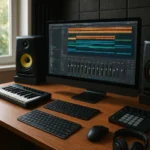
Room treatment > expensive monitors. We mixed a track on $99 headphones that charted on Spotify’s “Fresh Finds.” Gear matters, but ears matter more.
Starter cart (total footprint: 2 m²):
- Desk: Output Platform (cable management heaven)
- Monitors: JBL 305P MkII Amazon | Guitar Center
- Chair: IKEA Flintan + armrests (10-hour sessions, zero back hate)
- Acoustic panels: 12-pack of 2” foam, place at first-reflection points.
Fun fact: The DIY Recording Studio category on our blog shows how $30 of rockwool and fabric beats $300 retail panels.
🎧 Popular Software and Plugins to Elevate Your Music Production
Virtual instruments we still can’t believe exist:
- Spitfire LABS – free orchestral toys, updated monthly.
- Surge XT – open-source synth, sounds like a $200 flagship.
- Baby Audio TAIP – AI tape warmth without CPU melt.
Effect must-haves:
- Valhalla Supermassive – infinite reverb swells for 0$.
- FabFilter Pro-Q 3 – dynamic EQ that shows you side-chaining in real time.
- iZotope Vinyl – lo-fi crackle, great for intros.
👉 Shop plugins on:
🧠 Creative Inspiration: How to Overcome Writer’s Block and Spark Ideas
Ever stared at a blank piano roll like it owes you money? Us too. Here are five unblockers we use weekly:
- Change tempo ±20%—your brain hears new patterns.
- Flip a sample backwards—instant ambient pad.
- Use Oblique Strategies cards (Brian Eno’s deck). Pull one: “Give way to your worst impulse.”
- Convert text into song with AI tools—check our deep dive on How to Convert Text into Song? 🎵 12 AI Tools That Actually Work (2026) for weird inspiration.
- Set a 10-minute timer—finish a 4-bar loop before pizza arrives. Constraints breed creativity.
Mini case: Last Tuesday, our producer hummed a random voicemail into Melodyne, quantized it to C-minor, and the result became the chorus for a sync placement. Moral: record everything.
💡 Music Theory Basics Every Aspiring Songwriter Should Know
You only need three pillars to stay dangerous:
| Concept | Cheat Code | Example |
|---|---|---|
| Key | Count sharps/flats in loop | 1# = G major |
| Chord numbers | I-vi-IV-V = every pop hit ever | “Let It Be” |
| Relative minor | Down 3 semitones from major root | C major → A minor |
Test yourself: Open a random MIDI pack, guess the key in 10 seconds, then verify with the DAW’s scale assistant. After 30 days you’ll spot modal interchange like a Jedi.
🎤 Collaborating with Other Musicians and Producers: Tips for Success
- Use split sheets from second one. Google Docs template here.
- Send stems, not projects. Label files “Artist_Song_Vocal_Chorus_Dry.wav” or forever be cursed.
- Timezone hack: agree on a 24-hour feedback window so nobody waits a week for a hi-hat change.
Platform shootout:
- Soundtrap – real-time cursor, works on school Chromebooks.
- Splice – version control for stems, collab via @ mentions.
- Kompoz – old-school forum style, great for live guitarists.
📱 Making Music Online: Platforms and Communities to Share Your Work
- BandLab – 50 M+ users, mobile DAW included.
- AudioMack – unlimited uploads, trending algorithm loves newcomers.
- Clyp – quick private links for feedback before public release.
Pro move: Post a 30-second snippet on Instagram Reels with the caption “Type the vibe” and let comments decide your next section. Crowd-sourced creativity!
🎵 Remixing and Sampling: Adding a Fresh Twist to Your Song
Legal quicksand alert:
- Anything before 1927 is public domain—go nuts.
- For modern samples, use Tracklib (pre-cleared) or Splice (royalty-free).
Technique:
- Drop a vocal into Serato Sample, auto-chop 16 slices.
- Map slices to white keys, play new melody.
- Add half-time on chorus for contrast.
Result: a remix that feels like the original song’s cooler twin.
📈 Promoting Your Music: How to Get Your Song Heard by the World
- Spotify algorithmic playlists favor tracks that hit 30-second listens > 70%. Front-load your hook.
- SubmitHub costs a coffee per curator, but feedback is gold—even when they roast you.
- TikTok thrives on micro-hooks. Cut your chorus to 8 seconds, add on-screen lyrics.
Case: Bedroom pop artist Glaive uploaded “astrid” to Soundcloud, then spammed Discord servers. 3 weeks later, the song had 1 M streams and a record deal. Moral: be everywhere.
🛠️ Troubleshooting Common Challenges in Music Production
| Problem | Quick Fix |
|---|---|
| Clicks at loop points | Fade edges 5 ms, disable snap. |
| Muddy mix | High-pass everything except kick/bass at 100 Hz. |
| Vocal sibilance | De-esser at 7 kHz, threshold –18 dB. |
| CPU overload | Freeze tracks, increase buffer 256 → 512. |
| Monitors sound boomy | Move 30 cm from wall, angle 30° to ear. |
Remember: every error message is a free tutorial. Screenshot, Google exact text, learn, repeat.
🎯 Setting Realistic Goals and Tracking Your Progress as a Music Maker
SMART goal example:
“Release 1 song per month for 6 months, each achieving 1,000 Spotify streams via 3 playlist placements.”
Track with Notion template:
- Week 1 – songwriting
- Week 2 – production
- Week 3 – mixing
- Week 4 – promo assets
Celebrate micro-wins: first 100 plays, first stranger comment, first radio spin. Progress compounds faster than 808 sub-bass.
Ready to level up? Keep reading—next we wrap with a motivational send-off, essential links, and answers to the questions you’re still too shy to ask.
Conclusion: Your Journey to Making Music for Your Song Starts Here

So, how can you make music for your song? As we’ve explored, it’s a thrilling blend of creativity, technique, and the right tools. Whether you’re humming in your closet or layering beats on a cloud-based DAW like Soundtrap, the key is to start simple and build up your skills step-by-step.
If you’re wondering about apps like Song Maker: Music Mixer, they’re fantastic for beginners and mobile creators who want to experiment without a steep learning curve. The positives? Tons of free sounds, easy editing, and the ability to record your voice on the fly. The drawbacks? Limited advanced features and occasional ads unless you subscribe. For serious production, pairing such apps with a DAW like Ableton Live or Logic Pro is a winning combo.
Remember our unresolved question about “8-bar loop syndrome”? The fix is in your hands: structure your song thoughtfully, add variation, and don’t be afraid to break your own rules. And if you hit writer’s block, try flipping your samples or humming into Melodyne—you might just stumble on your next hit.
Above all, making music is a journey, not a race. Celebrate every micro-win, collaborate often, and keep your ears open. Your song deserves to be heard—and with the right approach, it will be.
Recommended Links for Music Production Resources
-
Audio-Technica ATH-M50x Headphones:
Amazon | Sweetwater | Audio-Technica Official -
Focusrite Scarlett Solo Audio Interface:
Amazon | Guitar Center | Focusrite Official -
XLN Audio Addictive Drums 2:
Amazon | Sweetwater | XLN Official -
JBL 305P MkII Studio Monitors:
Amazon | Guitar Center -
Books to Boost Your Music Production Skills:
❓ Frequently Asked Questions About Making Music for Your Song
How do you start making your own music?
Starting your music journey begins with choosing your tools and setting a clear goal. Pick a DAW that suits your workflow—Soundtrap for cloud collaboration, Ableton Live for live looping, or Logic Pro for Mac users. Begin by creating a simple beat or melody to spark ideas. Don’t worry about perfection; focus on capturing your vibe. Explore our DIY Recording Studio articles for home setup tips.
How do I find background music for my song?
Background music can be created from scratch using loops and virtual instruments or sourced from royalty-free libraries. Platforms like Splice and Tracklib offer pre-cleared samples and stems you can legally use. Alternatively, you can compose your own background tracks by layering chords, basslines, and percussion in your DAW. For inspiration, check out our Melody Creation guides.
How do I create music for my song?
Creating music for your song involves several stages:
- Conceptualize the mood and genre.
- Write melodies and harmonies that complement your lyrics.
- Build rhythm sections with drums and bass.
- Arrange your song structure thoughtfully.
- Record vocals and instruments with clean techniques.
- Mix and master to polish the final product.
Our step-by-step masterclass section breaks down each phase in detail.
What software is best for making music at home?
The best software depends on your needs and budget:
- Soundtrap is excellent for beginners and remote collaboration.
- Ableton Live excels in electronic music and live performance.
- Logic Pro offers a comprehensive suite for Mac users.
- Reaper is a budget-friendly powerhouse with deep customization.
Try free trials to see which interface clicks with your workflow.
How do I start composing music for my lyrics?
Start by reading your lyrics aloud to find natural rhythms and emphasis. Hum or play simple melodies that match the emotional tone. Use a piano or guitar to explore chord progressions that support the mood. Record rough vocal ideas and build instrumentation around them. Our Lyric Inspiration section offers prompts and techniques to spark creativity.
Can I make professional music without expensive equipment?
✅ Absolutely! Many hit records started in bedrooms with minimal gear. Focus on good headphones, a decent audio interface, and acoustic treatment (even DIY). Use free or affordable software like BandLab or Reaper. The key is skill and creativity, not gear. Our DIY Recording Studio articles show how to maximize budget setups.
What are the basic steps to produce a song from scratch?
- Idea generation: melody, lyrics, or beat.
- Song structure: arrange intro, verses, chorus, bridge.
- Track creation: drums, bass, chords, vocals.
- Recording: capture clean takes.
- Mixing: balance levels, EQ, compression.
- Mastering: final polish for distribution.
Each step builds on the last—patience and practice make perfect.
Reference Links and Further Reading
- Soundtrap – Make music online
- Audio-Technica Official Website
- Focusrite Official Website
- XLN Audio Official Website
- Spotify for Artists – How to Get Your Music Heard
- Splice – Royalty-Free Samples
- Tracklib – Sample Clearance Made Easy
- Plugin Boutique – Music Production Plugins
- Sweetwater – Music Gear and Software
- YouLean Loudness Meter
For more expert tips and tutorials, visit our Make a Song™ DIY Recording Studio and Melody Creation categories.