Support our educational content for free when you buy through links on our site. Learn more

🎵 Make Music in 2026: 25 Steps to Your First Song

You can make music today with a phone, laptop, free software, and one musical idea. Start with a beat, hum a melody, record a rough lyric, and shape those pieces into a song before worrying about expensive gear or advanced music theory.
At Make a Song™, we have watched plenty of “quick demos” grow into surprisingly strong tracks. One began as a voice memo recorded beside a noisy kettle; after a better arrangement, a tighter vocal, and a little automation, it had a chorus people remembered. The kettle did not receive a production credit.
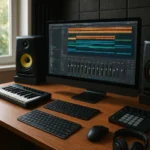
You do not need to play an instrument, read sheet music, or own a professional studio to begin. A digital audio workstation such as GarageBand, BandLab, Ableton Live, FL Studio, or Logic Pro can turn simple recordings and MIDI notes into complete music.
The real challenge is rarely finding another plugin. It is choosing an idea, developing it, finishing the arrangement, and resisting the urge to replace a good chorus with seventeen decorative synth layers. This guide shows you how to write, record, produce, mix, protect, and release your own music in 2026.
Key Takeaways
- Start with what you have: A phone, headphones, and a free music app are enough for your first song.
- Build the idea before buying gear: Melody, rhythm, lyrics, arrangement, and emotion matter more than an expensive studio.
- Use a repeatable workflow: Capture an idea, develop it, arrange sections, record, edit, mix, export, and revise.
- Learn essential music theory gradually: Chords, scales, rhythm, melody, and song structure become useful when connected to real songs.
- Create contrast: Verses, choruses, bridges, dynamics, silence, and changing instrumentation give a song momentum.
- Record cleanly at home: Microphone placement, gain staging, room control, and monitoring often matter more than premium equipment.
- Mix with restraint: Balance volume first, then use EQ, compression, reverb, delay, and automation to support the song.
- Protect your work: Document collaborators, credits, samples, licenses, compositions, and sound recordings.
- Finish small projects: A completed three-minute song teaches more than an unfinished album idea.
- Choose tools for the job: Use MakeMusic Cloud for structured music education and interactive practice; use a DAW for original songwriting and music production.
Table of Contents
- ⚡️ Quick Tips and Facts About Making Music
- 🎼 The History and Evolution of Music-Making
- 🎯 What Does It Mean to Make Music?
- Songwriting, Composition, Production, and Performance Explained
- How Music Ideas Become Finished Songs
- 🧭 Choose Your Musical Starting Point
- Make Music With Your Voice
- Make Music With an Instrument
- Make Music on a Computer, Tablet, or Phone
- Make Music Without Reading Sheet Music
- Make Music With AI Tools and Generative Technology
- 🛠️ The Essential Tools for Making Music
- Digital Audio Workstations: Ableton Live, Logic Pro, FL Studio, and More
- MIDI Controllers, Keyboards, and Drum Pads
- Microphones, Audio Interfaces, and Studio Headphones
- Studio Monitors, Cables, Stands, and Acoustic Treatment
- Free and Paid Music-Making Software
- 🎹 Learn the Building Blocks of Music
- Melody, Harmony, Rhythm, and Groove
- Scales, Chords, Keys, and Chord Progressions
- Song Structure: Verses, Choruses, Bridges, and Outros
- Tempo, Time Signatures, Dynamics, and Musical Feel
- Music Theory You Actually Need
- ✍️ How to Write a Song From Scratch
- 1. Find a Memorable Song Idea
- 2. Build a Chord Progression
- 3. Write a Strong Melody
- 4. Develop Meaningful Lyrics
- 5. Create a Catchy Chorus and Hook
- 6. Arrange the Song for Maximum Impact
- 7. Record a Rough Demo
- 8. Revise, Edit, and Finish the Song
- 🥁 How to Make Beats and Instrumentals
- Drum Patterns, Basslines, and Percussion
- Sampling, Sound Design, and Synthesizers
- Hip-Hop, Pop, EDM, Rock, Jazz, and Classical Production
- How to Make a Beat Without Expensive Equipment
- 🎙️ Recording Vocals and Instruments at Home
- How to Choose and Position a Microphone
- Recording Clean Vocals in a Bedroom Studio
- Tracking Guitar, Piano, Drums, and Other Instruments
- Latency, Gain Staging, Noise, and Room Reflections
- 🎚️ Music Production: Arrange, Edit, and Shape the Track
- Comping, Quantization, Tuning, and Timing Correction
- Layering Sounds Without Creating Mud
- Automation, Transitions, Builds, and Drops
- How to Make a Song Sound Professional
- 🎛️ Mixing Music for Clarity and Impact
- Volume Balance, Panning, and Stereo Width
- EQ, Compression, Reverb, Delay, and Saturation
- Mixing Vocals Over an Instrumental
- Mix-Bus Processing and Loudness
- Common Mixing Mistakes to Avoid
- 💿 Mastering and Releasing Your Music
- Mastering Basics for Streaming Platforms
- Audio Formats, Metadata, ISRC Codes, and Artwork
- Spotify, Apple Music, YouTube Music, and Bandcamp
- Music Distribution Services Compared
- How to Copyright a Song and Protect Your Work
- Royalties, Publishing, Sampling, and Music Licensing
- 📚 Music Education and Practice Resources
- How to Learn an Instrument and Build Consistent Practice Habits
- Sight-Reading, Ear Training, and Rhythm Practice
- Digital Sheet Music and Interactive Music Lessons
- MakeMusic Cloud: Interactive Practice for Students and Teachers
- A Vast Digital Sheet Music Catalog
- Sight Reading Studio for Daily Skill Building
- Dynamic Acompaniments for More Musical Practice
- Effortless Assignment Tracking and Grading
- The Foundations Series by Brian Balmages
- How MakeMusic Cloud Supports Teachers and Ensembles
- MakeMusic Cloud Compared With SmartMusic
- Compatible Devices, Browsers, and Accessories
- Learning Management System and Classroom Integrations
- 👩 🏫 Music Teaching Strategies That Improve Student Progress
- Assessment, Feedback, and Practice Data
- Differentiated Instruction for Beginners and Advanced Musicians
- Band, Orchestra, Choir, Piano, and General Music Resources
- Clinicians, Composers, and Music-Education Experts
- 🌟 Real-World Advice From Musicians and Producers
- How to Stay Creative When You Feel Stuck
- How to Finish More Songs
- Collaboration, Co-Writing, and Remote Music Production
- Building a Home Studio on Any Budget
- What Musicians Say About Digital Music-Making Tools
- ✅ 25 Practical Tips for Making Better Music
- Tips for Beginners Making Their First Song
- Tips for Faster Beatmaking and Songwriting
- Tips for Better Practice, Recording, and Mixing
- ❌ Common Music-Making Mistakes and How to Fix Them
- ❓ Frequently Asked Questions About Making Music
- Can I Make Music Without Knowing Music Theory?
- What Is the Best Software for Making Music?
- Can I Make Music on My Phone or Tablet?
- How Do I Make Music for Free?
- How Long Does It Take to Make a Song?
- How Do I Make Music From a Sound in My Head?
- How Do I Make Music With AI Responsibly?
- What Devices Work With MakeMusic Cloud?
- How Does MakeMusic Cloud Help With Grading?
- Is MakeMusic Cloud Suitable for Beginner Musicians?
- Can MakeMusic Cloud Connect to an Existing LMS?
- What Music Is Available in the MakeMusic Cloud Catalog?
- Is There a Free Trial for MakeMusic Cloud?
- 🔗 Recommended Music-Making Links and Learning Resources
- 📖 Reference Links and Trusted Music Industry Sources
- 🎵 Conclusion
Quick Tips and Facts About Making Music
🎵 7 Benefits of Using a Song Generator to Make Music (2026) is a useful starting point if you want fast ideas, unusual prompts, or a friendly shove past the dreaded blank page.
Fast Answers Before We Turn the Amps On
| Question | Practical answer |
|---|---|
| Can anyone make music? | ✅ Yes. You can begin with humming, tapping a rhythm, recording a voice memo, or arranging loops. |
| Do you need music theory? | ❌ Not to begin. ✅ Theory becomes valuable when you want to understand, repeat, and improve what your ears already like. |
| What is the easiest setup? | A smartphone, headphones, and a beginner-friendly app such as GarageBand, BandLab, or FL Studio Mobile. |
| What is a DAW? | A digital audio workstation, such as Ableton Live, Logic Pro, FL Studio, or REAPER, used to record, arrange, edit, mix, and export music. |
| How long does a song take? | A sketch can take 20 minutes; a polished release may take days or weeks. The finish line moves when you keep adding “just one more hi-hat.” |
| What matters most? | A strong musical idea, clear arrangement, intentional sound choices, and finishing the track. Expensive gear comes later. |
The U.S. Copyright Office explains that original musical works can receive copyright protection, but an idea alone generally is not protected. That distinction matters: your recorded melody, lyrics, and arrangement are assets; the vague thought “I want a sad pop song” is not.
Our 10-Minute Starter Challenge
Try this before downloading twelve synthesizers:
- Open BandLab, GarageBand, or your current DAW.
- Set the tempo between 90 and 110 BPM.
- Record a four-bar drum pattern or clap one into your phone.
- Add a simple bass note on the first beat of each bar.
- Hum a melody over it.
- Record one lyric line, even if it is gloriously imperfect.
- Duplicate the idea and change the final bar.
- Save the project as Song Idea 001.
That tiny sketch answers a question many beginners wrestle with: Can I actually make music? Yes. You just made a musical decision, captured it, and created something that did not exist ten minutes earlier.
Our Quick Rules for Better Results
- Start with a limitation. Four tracks can produce more focus than 400 plugins.
- Record before judging. The idea in your head is wearing studio lighting; the recording is wearing sweatpants.
- Use reference tracks carefully. Compare arrangement, bass balance, vocal placement, and energy, not someone else’s identity.
- Leave headroom. Avoid recording every channel too loudly.
- Finish small songs. Three completed sketches teach more than one eternal “masterpiece.”
- Name and back up your files. Use folders for projects, audio, samples, exports, and revisions.
- Check sample licenses. Splice, Loopmasters, and other providers have license terms that vary by service and content. Read the relevant Splice Sounds licensing information.
- Protect your ears. The World Health Organization recommends safe listening practices, including taking breaks and reducing excessive volume.
The History and Evolution of Music-Making

Music-making has always mixed human instinct, available tools, and cultural context. The tools changed dramatically; the core loop did not:
Hear something → make a choice → repeat or contrast it → share it with someone.
From Voice and Hands to Recording Studios
Before notation, musicians passed songs through memory and performance. Written notation later made it possible to preserve and distribute musical instructions more consistently. The Library of Congress documents how printed sheet music helped circulate songs to homes, schools, and performers.
The modern recording era added a new possibility: music could be captured, edited, copied, and replayed without the original performer being present.
| Era | Major tools | What changed |
|---|---|---|
| Ancient and oral traditions | Voice, percussion, string and wind instruments | Music traveled through memory, community, and performance |
| Written notation | Manuscripts and printed scores | Composers could preserve complex musical instructions |
| Mechanical recording | Cylinders and discs | Performances became repeatable objects |
| Electrical recording | Amplification and microphones | Softer sounds and larger ensembles became easier to capture |
| Multitrack tape | Tape machines and consoles | Producers could layer and edit separate performances |
| MIDI era | Drum machines, synthesizers, sequencers | Musical instructions became programmable |
| DAW era | Computers, plugins, digital editing | One person can compose, record, mix, and release from home |
| Cloud and mobile era | Phones, browsers, collaboration platforms | Ideas can be made and shared almost anywhere |
The Smithsonian offers useful historical context on recording technology, while MIDI.org documents the standard that helped electronic instruments and computers communicate.
The Producer’s Role Changed
Early recording engineers often documented a performance. Modern producers may:
- Write or co-write the song
- Program drums
- Select sounds
- Arrange sections
- Edit timing
- Tune vocals
- Shape transitions
- Mix the record
- Coordinate mastering and release
That does not make one role “more musical” than another. A drummer who creates a groove is making production decisions. A vocalist who changes one syllable is arranging emotion. A producer who removes half the track may be doing the most important work in the room.
From Tape Splicing to Digital Editing
Tape editing required physical cuts and joins. DAWs let you edit non-destructively, duplicate sections, reverse audio, stretch timing, and automate effects. That convenience is powerful, but it creates a trap: because editing is easy, endless editing is also easy.
We have watched promising songs lose their personality under microscopic correction. A slightly early snare may be the thing that makes a groove feel alive. Correct the problem, not the existence of humanity.
What Does It Mean to Make Music?
“Make music” can mean several related activities. Knowing which job you are doing prevents confusion and helps you choose the right tools.
Songwriting, Composition, Production, and Performance Explained
| Role | Main question | Typical output |
|---|---|---|
| Songwriting | What should the listener hear and feel? | Lyrics, melody, chords, song form |
| Composition | How are musical ideas organized? | A written or recorded musical work |
| Arrangement | Which instruments play what, and when? | Instrument parts, builds, drops, textures |
| Production | How should the record sound and evolve? | Sounds, edits, transitions, sonic identity |
| Recording | How do we capture the performance? | Vocal, instrument, or live tracking |
| Mixing | How do all elements fit together? | Balanced stereo mix |
| Mastering | Is the final release consistent and ready? | Distribution-ready master |
| Performance | How does the music become a live or recorded expression? | A delivery with timing, tone, and emotion |
A person can do all eight jobs one laptop. That is liberating, but also a little like being the chef, waiter, dishwasher, and restaurant critic at the same time.
How Music Ideas Become Finished Songs
A reliable workflow usually looks like this:
- Capture a musical idea.
- Choose a tempo, key, and emotional direction.
- Develop the strongest motif.
- Arrange contrast between sections.
- Record or program the parts.
- Edit obvious distractions.
- Mix for balance and translation.
- Master or export responsibly.
- Test on headphones, speakers, a car, and a phone.
- Release, archive, and learn from the result.
The order can change. Some producers begin with a vocal, others with a drum loop, bassline, guitar riff, or lyric. The first YouTube video’s five-element method starts with drums, bass, mids, vocals, and effects, and its central advice is practical: build the foundation, then add color. You can watch the featured video here when you reach the production workflow section.
Three Useful Definitions of “Finished”
A song is finished when:
- The arrangement communicates its idea
- The mix translates acceptably across playback systems
- You can explain why further changes improve it
“Finished” does not mean flawless. It means the remaining imperfections no longer outweigh the cost of continuing.
Choose Your Musical Starting Point
There is no single correct entrance. Pick the path that makes you want to return tomorrow.
Make Music With Your Voice
Your voice is a melody instrument, rhythm instrument, lyric delivery system, and sound-design source.
Try:
- Humming a melody before writing words
- Recording spoken phrases and chopping them rhythmically
- Stacking harmonies one part at a time
- Using breath sounds as transitions
- Singing nonsense syllables to avoid lyric self-consciousness
For lyric development, our Lyric Inspiration resources can help you move from an emotion to concrete images.
Make Music With an Instrument
A basic guitar, keyboard, ukulele, drum pad, or even a kitchen table can become a starting point. If you are learning an instrument, focus first on:
- A small collection of chords or notes
- A steady pulse
- One recognizable song form
- Listening while you play
- Recording yourself regularly
Our Instrument Tutorials are useful when technique is blocking creativity.
Make Music on a Computer, Tablet, or Phone
| Platform | Good for | Watch out for |
|---|---|---|
| GarageBand | Beginners, Apple users, quick demos | Less flexible than full desktop DAWs |
| BandLab | Browser-based collaboration and free sketches | Cloud workflow requires account and internet features |
| FL Studio | Beatmaking, piano roll, electronic production | Large feature set can feel crowded |
| Ableton Live | Loop-based writing, electronic music, live performance | Arrangement view takes practice |
| Logic Pro | Full production on Mac and iPad | Apple-only ecosystem |
| REAPER | Recording, customization, efficient workflows | Interface is less immediately friendly |
| Pro Tools | Professional recording and editing environments | More setup and workflow complexity |
| Cubase | Composition, MIDI, recording, mixing | Deep menus reward patience |
Check the current official system requirements for Ableton Live, Logic Pro, FL Studio, and REAPER before choosing a platform.
Make Music Without Reading Sheet Music
You can create using:
- Piano-roll MIDI editing
- Chord charts
- Loop arrangement
- Audio recording
- By-ear imitation
- Finger patterns
- Visual waveforms
- Drum-grid sequencing
Notation remains valuable for communicating with other musicians, preserving arrangements, and developing reading skills. It is a language, not an entry ticket.
Make Music With AI Tools and Generative Technology
AI can help generate prompts, chord suggestions, rough arrangements, lyric angles, or sound variations. Use it as a creative assistant, not an automatic substitute for taste.
Before releasing AI-assisted material, check:
- The tool’s commercial-use terms
- Training-data and ownership policies
- Whether generated output is exclusive
- Sample and voice-licensing restrictions
- Platform disclosure requirements
- Human contribution to the final work
The U.S. Copyright Office’s AI initiative provides current guidance on copyright and human authorship. Laws and platform policies continue to develop, so do not treat a tool’s marketing page as legal advice.
The Essential Tools for Making Music
Digital Audio Workstations: Ableton Live, Logic Pro, FL Studio, and More
A DAW is the central workspace for recording, MIDI, editing, arrangement, mixing, and export.
| DAW | Best fit | Strength | Limitation |
|---|---|---|---|
| Ableton Live | Electronic producers and performers | Session View, warping, flexible modulation | Arrangement workflow feels different from traditional linear DAWs |
| Logic Pro | Mac and iPad musicians | Instruments, effects, notation, recording tools | Requires Apple hardware |
| FL Studio | Beatmakers and electronic producers | Piano roll, pattern workflow, fast sequencing | Recording workflows may need customization |
| REAPER | Budget-conscious recordists and tinkers | Lightweight, deep routing, customization | Stock presentation is utilitarian |
| Pro Tools | Recording studios and post-production | Editing, session interchange, industry familiarity | Hardware and workflow expectations can be substantial |
| Cubase | Composers and producers | MIDI, scoring, orchestration, mixing | Extensive features require a learning curve |
| GarageBand | New Apple users | Immediate songwriting and recording | Limited compared with professional DAWs |
| BandLab | Online creators and collaborators | Browser access and social collaboration | Less detailed than desktop systems |
Our recommendation: choose the DAW that matches your immediate work. If you want beats and loops, test FL Studio or Ableton Live. If you record guitar and vocals on a Mac, GarageBand or Logic Pro is a sensible route. If you need flexible audio routing and a lightweight install, investigate REAPER.
MIDI Controllers, Keyboards, and Drum Pads
MIDI controllers do not usually produce sound alone. They send performance information such as:
- Note
- Velocity
- Duration
- Pitch bend
- Modulation
- Knob and fader movement
A compact controller such as the Novation Launchkey Mini, Akai MPK Mini, or Arturia MiniLab can make programming less mouse-heavy.
Buy a controller for the movement you need, not because a desk full of glowing pads looks like a spaceship.
Microphones, Audio Interfaces, and Studio Headphones
A simple recording chain is:
Sound source → microphone → interface preamp → DAW → headphones or monitors
| Tool | Purpose | Typical choice |
|---|---|---|
| Dynamic microphone | Handles loud sources and untreated rooms well | Shure SM58 |
| Large-diaphragm condenser | Detailed vocals and acoustic instruments | Audio-Technica AT2020 |
| Audio interface | Converts analog sound to digital and back | Focusrite Scarlett Solo |
| Closed-back headphones | Tracking with minimal microphone bleed | Sony MDR-7506 |
| Open-back headphones | More natural mixing perspective | Beyerdynamic DT 990 Pro |
| Studio monitors | Speaker-based mixing and translation checks | Yamaha HS5 or JBL 305P MkII |
Link to the Shure SM58, Audio-Technica AT2020, Focusrite Scarlett Solo, Sony MDR-7506, and Yamaha HS Series for current specifications.
Studio Monitors, Cables, Stands, and Acoustic Treatment
A monitor does not fix a poor room. Before purchasing expensive speakers:
- Place monitors symetrically.
- Keep tweters near ear height.
- Form an equilateral triangle between you and the speakers.
- Avoid pushing speakers directly into corners.
- Add broadband absorption where practical.
- Use a stable microphone stand.
- Keep power and audio cables organized.
- Label the cables you will inevitably unplug while “improving” the setup.
The Audio Engineering Society publishes technical resources on acoustics and audio engineering. For beginners, the biggest acoustic upgrade is often better listening position and controlled reflections, not another plugin.
Free and Paid Music-Making Software
Free tools can be excellent:
- GarageBand
- BandLab
- Audacity
- Cakewalk by BandLab
- Waveform Free
- Vital
- Surge XT
- Spitfire Audio LABS
Paid software may offer deeper instruments, workflow tools, support, and professional interoperability. Do not confuse “free” with “simple”; some free tools have enough power to keep you busy until your next birthday.
Learn the Building Blocks of Music
Melody, Harmony, Rhythm, and Groove
- Melody: the sequence you can sing or remember.
- Harmony: notes sounding together and their movement.
- Rhythm: time organization.
- Grove: the feel created by timing, accents, repetition, and interaction.
A melody can be simple and still compelling if its rhythm, phrasing, and sound are distinctive. A complicated melody can feel forgetable if it has no conversational shape.
Scales, Chords, Keys, and Chord Progressions
Start with the major scale pattern and learn how triads are built from alternating scale degrees. In C major:
| Scale degree | Chord |
|---|---|
| I | C major |
| ii | D minor |
| iii | E minor |
| IV | F major |
| V | G major |
| vi | A minor |
| vii° | B diminished |
Common progressions such as I–V–vi–IV work because listeners recognize their movement, not because they are magic spells. Familiar harmony becomes fresh through melody, rhythm, voicing, instrumentation, and production.
For practical melodic exercises, explore our Melody Creation category.
Song Structure: Verses, Choruses, Bridges, and Outros
A common pop structure is:
Intro → Verse → Pre-Chorus → Chorus → Verse → Chorus → Bridge → Final Chorus → Outro
Structure is emotional architecture:
- Verse: details, setup, narrative
- Pre-chorus: rising tension
- Chorus: central idea and payoff
- Bridge: contrast or new perspective
- Outro: release, repetition, or disappearance
You can break every rule, but first understand what the rule is doing. A chorus cannot feel larger if every section is already shouting.
Tempo, Time Signatures, Dynamics, and Musical Feel
Tempo is measured in BPM. Time signature describes the recurring grouping of beats. Dynamics describe loudness and intensity, but production dynamics also include:
- Density
- Register
- Harmonic tension
- Stereo width
- Distortion
- Silence
A chorus can feel bigger without becoming much louder. Add octave doubling, wider guitars, longer reverb, busier percussion, or a more open vocal arrangement.
Music Theory You Actually Need
Learn these in order:
- Beat and subdivision
- Major and minor scales
- Intervals
- Triads and seventh chords
- Diatonic harmony
- Rhythm notation or piano-roll timing
- Key changes and borrowed chords
- Voice leading
Theory should explain what you hear. If someone says “that is a secondary dominant” and the song suddenly becomes less enjoyable, take a breath. The chord did not ask for a diploma.
How to Write a Song From Scratch
1. Find a Memorable Song Idea
Choose one emotional sentence:
- “I want to leave, but I keep checking the door.”
- “The party ended, but the room still sounds like you.”
- “I am proud of surviving, not pretending I was fine.”
Specific images beat broad declarations. “I miss you” is understandable; “your coffee mug is still facing the window” gives the listener somewhere to stand.
2. Build a Chord Progression
Try one of these approaches:
- Start with four chords.
- Hold one chord and vary the melody.
- Write a bassline first.
- Use a pedal tone beneath changing chords.
- Borrow a chord from the parallel minor or major key.
- Play the progression on a different instrument than usual.
Record the progression immediately. Memory edits more aggressively than you think.
3. Write a Strong Melody
Use a contour:
- Begin in a comfortable range.
- Repeat a small motif.
- Change the ending.
- Reserve the highest note for a meaningful phrase.
- Leave space after important words.
- Test the melody without the chords.
If it works when sung with only a metronome, it has structural strength.
4. Develop Meaningful Lyrics
A reliable lyric draft uses:
- A point of view
- A concrete setting
- A repeated phrase
- A contrast
- Sensory details
- A change in perspective
Draft quickly, edit slowly. During revision, remove filler words, replace clichés, and read the lyrics aloud. Our Lyric Inspiration category includes exercises for images, hooks, and song concepts.
5. Create a Catchy Chorus and Hook
A hook may be:
- A lyric phrase
- A rhythmic figure
- A melodic leap
- A distinctive sound
- A repeated production moment
The best hook is not always the loudest part. Sometimes it is a tiny rhythmic answer after the vocal line, the sonic equivalent of an eyebrow raise.
6. Arrange the Song for Maximum Impact
Create contrast with:
- Fewer instruments in the verse
- More low-end in the chorus
- Different drum patterns
- Changed vocal doubles
- New harmonic color
- Strategic silence
- A pre-chorus that removes the kick before the drop
Do not add layers merely because empty tracks make you nervous.
7. Record a Rough Demo
A demo should answer:
- Does the song work?
- Is the chorus clear?
- Is the vocal range realistic?
- Does the second verse add information?
- Is the ending intentional?
Use a phone recording if necessary. A rough demo is a map, not a museum exhibit.
8. Revise, Edit, and Finish the Song
Make separate passes:
- Song pass: lyrics, melody, chords, structure
- Arrangement pass: instrumentation and dynamics
- Performance pass: timing, pitch, expression
- Mix pass: balance, space, tone
- Release pass: metadata, artwork, credits, rights
This separation prevents you from trying to solve a weak chorus with a compressor.
How to Make Beats and Instrumentals
Drum Patterns, Basslines, and Percussion
Begin with a dependable pulse:
- Place the kick on the main structural beats.
- Add a snare or clap to define the backbeat.
- Add hi-hats with a simple subdivision.
- Vary velocity.
- Remove hits before adding more.
- Add fills only at transitions.
A beat can feel human through small timing and velocity differences. Randomness is not the same as feel; a drummer does not roll dice before every snare.
Sampling, Sound Design, and Synthesizers
When sampling:
- Check the license.
- Keep source files and documentation.
- Transform material creatively.
- Avoid assuming “it is online” means “it is cleared.”
- Credit collaborators and creators where required.
For sound design, change one variable at a time:
- Oscillator waveform
- Filter cutoff
- Resonance
- Envelope attack and release
- LFO rate
- Distortion
- Delay feedback
- Reverb decay
This makes cause and effect audible. If you twist every knob at once, you have not designed a sound; you have startled a synthesizer.
Hip-Hop, Pop, EDM, Rock, Jazz, and Classical Production
| Style | Production priorities |
|---|---|
| Hip-hop | Pocket, kick-and-bass relationship, vocal presence, sampling ethics |
| Pop | Hook clarity, vocal production, contrast, polished low end |
| EDM | Energy curve, kick/bass cohesion, builds, drops, stereo design |
| Rock | Performance energy, drum room, guitar arrangement, vocal attitude |
| Jazz | Interaction, dynamics, room sound, improvisational space |
| Classical | Ensemble balance, room acoustics, natural dynamics, score fidelity |
Genre conventions are starting coordinates, not prison bars.
How to Make a Beat Without Expensive Equipment
Use:
- A free DAW
- One drum kit
- One bass sound
- A phone microphone
- Household percussion
- A single synth
- Automation
- Silence
The first YouTube video’s “five elements” approach is useful because it prevents the common beginner mistake of adding layers before the rhythm section works. Its producer builds from drums and bass, then fills the midrange, adds vocals, and finishes with effects. That sequence is not universal, but it is a strong training framework.
Recording Vocals and Instruments at Home
How to Choose and Position a Microphone
For a vocal recording:
- Face away from noisy windows and computers.
- Place the microphone at mouth height.
- Use a pop filter.
- Keep a consistent distance.
- Angle the microphone slightly off-axis if harsh consonants dominate.
- Record a test phrase.
- Listen for room reflections before performing the full take.
A dynamic microphone can be forgiving in an untreated room. A condenser may capture more detail and more room. The best microphone is the one that suits the source and environment.
Recording Clean Vocals in a Bedroom Studio
Treat the space, not just the microphone:
- Hang thick absorption behind or beside the performer.
- Avoid recording in the exact center of a square room.
- Turn off fans and noisy appliances.
- Record several seconds of room tone.
- Keep the interface input out of the red.
- Capture multiple takes rather than forcing one heroic take.
Our DIY Recording Studio category covers practical home-recording improvements.
Tracking Guitar, Piano, Drums, and Other Instruments
For acoustic guitar:
- Test 12th-fret and bridge positions.
- Avoid pointing directly at the sound hole.
- Record a rhythm take before overdubbing parts.
For piano:
- Use MIDI when you need editability.
- Use microphones when the instrument’s physical character matters.
- Check pedal noise and room reflections.
For drums:
- Tune before miking.
- Capture a coherent performance.
- Resist replacing every hit before hearing the room and drummer.
For electric guitar:
- Record the amplifier or use a modeling plugin.
- Place a microphone near the speaker cone, then move it by inches.
- Record a clean safety track when possible.
Latency, Gain Staging, Noise, and Room Reflections
| Problem | Likely cause | First fix |
|---|---|---|
| Vocal sounds delayed | Buffer size too high | Lower interface buffer while tracking |
| Recording is distorted | Input gain too high | Reduce preamp gain and test peaks |
| Hiss between phrases | Noisy room, cable, or high gain | Shorten signal path and improve source level |
| Room sounds boxy | Reflections and poor placement | Move position and add absorption |
| Guitar sounds thin | Mic position or phase issue | Test placement and mono compatibility |
| Playback clicks | CPU overload or sample-rate mismatch | Increase buffer during mixing and check settings |
The Federal Communications Commission and audio manufacturers offer technical resources on interference, but many home-studio noises are wonderfully unglamorous: a refrigerator, laptop fan, loose cable, or fluorescent light.
Music Production: Arrange, Edit, and Shape the Track
Comping, Quantization, Tuning, and Timing Correction
Use editing to improve communication:
- Comping: choose the best phrases from multiple takes.
- Quantization: align MIDI or audio closer to the grid.
- Tuning: correct distracting pitch problems.
- Time correction: repair obvious timing issues.
- Breath editing: control distracting breaths without removing expression.
Human timing is information. Quantize the part that is supposed to lock; preserve the part that is supposed to breathe.
Layering Sounds Without Creating Mud
Mud often collects in the low-midrange. Prevent it by:
- Giving instruments different registers
- Removing unnecessary low frequencies
- Choosing complementary sounds
- Panning supporting parts
- Automating competing elements
- Simplifying the arrangement
Ask of every track: What does this add that another track does not?
Automation, Transitions, Builds, and Drops
Automation can control:
- Volume
- Pan
- Filter cutoff
- Reverb send
- Delay feedback
- Distortion
- Stereo width
- Vocal effects
The featured production video demonstrates automation by changing effects such as drive over time. That matters because a static effect is decoration; a changing effect becomes part of the arrangement.
For transitions:
- Reduce or filter the low end.
- Add a riser, reverse sound, or tom fill.
- Increase tension with automation.
- Create a brief pause.
- Let the next section arrive with a clear first beat.
How to Make a Song Sound Professional
Professional sound usually comes from many ordinary decisions:
- Strong source recordings
- Arrangement with contrast
- Controlled low end
- Clear vocal priorities
- Appropriate effects
- Consistent editing
- Reference listening
- Translation checks
- A deliberate master
A polished mix cannot rescue a chorus with no emotional payoff. Production is paint; songwriting is the architecture underneath.
Mixing Music for Clarity and Impact
Volume Balance, Panning, and Stereo Width
Begin with volume, not plugins:
- Pull every fader down.
- Bring up the lead vocal or primary instrument.
- Add kick and bass.
- Introduce supporting elements one at a time.
- Pan complementary parts.
- Check the mix quietly.
- Listen in mono.
If the song collapses in mono, investigate phase, stereo widening, and doubled parts. The Audio Engineering Society provides technical publications for deeper study.
EQ, Compression, Reverb, Delay, and Saturation
| Tool | Main job | Common mistake |
|---|---|---|
| EQ | Balance frequencies | Boosting everything instead of removing conflict |
| Compression | Control dynamics and shape impact | Crushing the life out of a performance |
| Reverb | Create space and depth | Washing every track in the same large room |
| Delay | Add repeats and rhythm | Leting repeats obscure the lyric |
| Saturation | Add harmonics and density | Mistaking distortion for loudness |
| Limiter | Control peaks and raise level | Using it to fix a broken mix |
Use bypass frequently. If you cannot hear the improvement, the plugin may be performing expensive theater.
Mixing Vocals Over an Instrumental
A vocal usually needs:
- Clean editing
- Gentle corrective EQ
- Controlled dynamics
- De-essing when necessary
- Short ambience or delay
- Automation for phrase-level balance
- Space carved from competing instruments
Do not automatically make the vocal bright and loud. A dark, intimate vocal may suit the song better than a hyped one.
Mix-Bus Processing and Loudness
Mastering engineer Ian Shepherd’s Dynamic Range Day resources explain why loudness and dynamics deserve thoughtful treatment. Streaming normalization means louder is not automatically better.
Export a clean mix with reasonable headroom, compare against references at matched loudness, and avoid clipping unless it is an intentional creative choice.
Common Mixing Mistakes to Avoid
- Mixing too loudly
- Adding plugins before balancing levels
- Ignoring the room
- Over-compressing the master
- Using reverb to hide poor arrangement
- Monitoring only on expensive headphones
- Making decisions while exhausted
- Comparing an unfinished mix to a mastered commercial release
Mastering and Releasing Your Music
Mastering Basics for Streaming Platforms
Mastering involves final tonal balance, dynamics, sequencing, metadata, and translation. Spotify publishes technical guidance in its loudness normalization documentation, while Apple provides music delivery guidance.
Platform targets and encoding practices can change. Treat loudness numbers as guidance, not a finish-line superstition.
Audio Formats, Metadata, ISRC Codes, and Artwork
Maintain:
- High-resolution WAV masters
- Instrumental and clean versions
- Stems when relevant
- Accurate songwriter and producer credits
- ISRC information
- Composer and publisher data
- Cover artwork meeting distributor requirements
- Session backups
The International ISRC Agency explains how International Standard Recording Codes identify recordings.
Spotify, Apple Music, YouTube Music, and Bandcamp
Each platform serves a different purpose:
- Spotify: playlist discovery and streaming habits
- Apple Music: lossless and spatial delivery options
- YouTube Music: video ecosystem and search visibility
- Bandcamp: direct fan relationships and artist-controlled sales
- SoundCloud: informal sharing, discovery, and community feedback
Do not distribute blindly. Decide whether your goal is reach, direct support, sync licensing, portfolio building, or audience testing.
Music Distribution Services Compared
| Distributor type | Advantage | Trade-off |
|---|---|---|
| Aggregator | Broad platform delivery | Fees, policies, and support vary |
| Label services | Strategy and industry support | Less independence and greater selectivity |
| Direct platform upload | Strong control in limited contexts | Not available for every major service |
| DIY release | Maximum ownership | You handle metadata, promotion, and administration |
Read current terms from services such as DistroKid, TuneCore, CD Baby, and UnitedMasters before choosing.
How to Copyright a Song and Protect Your Work
Copyright usually separates:
- The musical composition: melody, lyrics, harmony
- The sound recording: the recorded performance
The U.S. Copyright Office provides registration information. Keep dated project files, split sheets, lyric drafts, collaborator agreements, and sample licenses.
Visit our Copyright and Licensing category for practical release and rights guidance.
Royalties, Publishing, Sampling, and Music Licensing
Potential revenue streams include:
- Master recording royalties
- Mechanical royalties
- Performance royalties
- Sync licensing
- Neighboring rights
- Direct sales
- Membership and fan support
Organizations such as ASCAP, BMI, SESAC, and SoundExchange explain different rights and collection systems. Rules vary by territory, so document every contributor before release.
Music Education and Practice Resources
How to Learn an Instrument and Build Consistent Practice Habits
Use a repeatable session:
- 3 minutes: warm up
- 5 minutes: technique
- 10 minutes: difficult passage
- 10 minutes: repertoire
- 2 minutes: record and review
Short, frequent practice beats heroic sessions followed by three weeks of avoidance. A practice log should track what changed, not merely how long you sat near the instrument.
Sight-Reading, Ear Training, and Rhythm Practice
Develop several skills together:
- Clap rhythms before playing them.
- Sing scale degrees.
- Identify intervals by sound.
- Read short excerpts daily.
- Practice with a metronome.
- Transcribe simple melodies.
- Play phrases in multiple keys.
Digital Sheet Music and Interactive Music Lessons
Interactive tools can provide:
- Scrolling notation
- Tempo control
- Play-along accompaniment
- Note and rhythm feedback
- Assignment tracking
- Repertoire discovery
- Practice analytics
These tools support practice; they do not replace listening, teacher feedback, or ensemble experience.
MakeMusic Cloud: Interactive Practice for Students and Teachers
MakeMusic Cloud is a web-based music education platform that evolved from SmartMusic. Its official site describes a catalog of more than 10,000 interactive titles and more than 200 method books. Explore MakeMusic Cloud for current repertoire, features, compatibility, and trial information.
Rating Snapshot
| Category | Rating / 10 | Our view |
|---|---|---|
| Interface concept | 8 | Clear practice-and-assignment purpose |
| Interactive feedback | 9 | Useful for pitch and rhythm awareness |
| Repertoire breadth | 9 | Particularly strong for school ensemble education |
| Teacher workflow | 9 | Assignment and assessment tools save administrative time |
| Beginner support | 8 | Structured materials help, though guidance still matters |
| LMS integration | 8 | Google Classroom, Schoology, and Canvas support are valuable |
| Independent practice | 9 | Acompaniments and immediate feedback encourage repetition |
| Device flexibility | 8 | Broad web access, but experience depends on device and connection |
| Advanced creative production | 4 | Designed for music learning, not a replacement for a DAW |
| Overall fit for educators | 9 | Strong option for organized instrumental practice |
A Vast Digital Sheet Music Catalog
MakeMusic lists repertoire across:
- Band
- Orchestra
- Choir
- Solo instruments
- Jazz
- Classical music
- Pop arrangements
- Method books
- Small ensembles
- Festival and approved-list selections
Catalog suitability depends on your instrument, grade level, region, and licensing access. Search the official catalog rather than assuming a specific title is included.
Sight Reading Studio for Daily Skill Building
Sight Reading Studio can make reading practice more measurable by presenting material, controlling tempo, and supporting repeated attempts. The benefit is not merely “getting more pages.” It is creating a routine where students encounter unfamiliar notation without waiting for a teacher to assign every exercise.
Dynamic Acompaniments for More Musical Practice
Acompaniments can make solo practice feel less like playing into a cupboard. One student testimonial quoted by MakeMusic described the experience as:
“Playing along with MakeMusic was like I was playing with others, not just myself alone in my room.”
That is a persuasive benefit for motivation. Still, accompaniment should not hide unstable rhythm. Practice once with support, then once without it.
Effortless Assignment Tracking and Grading
MakeMusic describes automatic assessment for pitch and rhythm and grade pass-back support for Google Classroom. Kimberly Bene, a middle-school band director quoted on the company site, said students appreciated checking fingerings and verifying whether they played correctly, while the platform helped manage multiple weekly assignments.
Teacher perspective matters here: automated feedback can reduce repetitive checking, but a computer may not understand musical intention, tone quality, stylistic nuance, or why a student suddenly stopped playing. Use scores as evidence, not as the entire lesson.
The Foundations Series by Brian Balmages
The Foundations Series by Brian Balmages is positioned as a structured, standards-aligned resource for beginning musicians. It aims to build:
- Musical literacy
- Fundamental technique
- Ensemble awareness
- Progressive confidence
- Repertoire familiarity
Use a method series as a pathway, not a cage. Beginners still need songs that sound exciting enough to make practice feel like music rather than paperwork.
How MakeMusic Cloud Supports Teachers and Ensembles
MakeMusic Cloud can assist with:
- Repertoire discovery
- Assignment distribution
- At-home practice
- Pitch and rhythm checks
- Progress monitoring
- LMS workflows
- Ensemble preparation
Its strongest use case is organized music education. It is not intended to replace Ableton Live, Logic Pro, or another DAW for songwriting and commercial music production.
MakeMusic Cloud Compared With SmartMusic
MakeMusic presents Cloud as the successor to SmartMusic. The sensible comparison is practical:
| Area | SmartMusic legacy experience | MakeMusic Cloud |
|---|---|---|
| Delivery | Earlier platform experience | Web-based access and updated workflows |
| Catalog | Large interactive repertoire | Expanded and continuously developing catalog |
| Assessment | Practice and feedback tools | Pitch, rhythm, assignments, and progress features |
| Classroom workflow | Educator-focused | LMS integrations and modern assignment management |
| Best question to ask | “Did we use SmartMusic?” | “Does the current Cloud catalog and workflow fit us?” |
Do not assume every historical SmartMusic feature, title, or workflow behaves identically today. Check current documentation and trial access.
Compatible Devices, Browsers, and Accessories
MakeMusic describes access across:
- Windows computers
- macOS computers
- Chromebooks
- iPads
- Android tablets
- Smartphones
Practical accessories may include:
- A reliable internet connection
- Headphones
- A microphone when required
- A device stand
- Instrument-specific setup
Test your exact device, browser, microphone, and school network before assigning a full class.
Learning Management System and Classroom Integrations
The platform highlights integrations with:
- Google Classroom
- Schoology
- Canvas
Integration can reduce duplicated work, but administrators should verify:
- Student account provisioning
- Privacy requirements
- Grade pass-back behavior
- Browser compatibility
- District network restrictions
- Teacher permissions
The company quotes a Georgia K–12 fine-arts director saying MakeMusic was the only platform evaluated that met the program’s robust data-security needs. That is a valuable reported perspective, but schools should still conduct their own vendor review.
Music Teaching Strategies That Improve Student Progress
Assessment, Feedback, and Practice Data
Useful feedback is:
- Specific
- Timely
- Actionable
- Connected to a musical goal
“Wrong note” is less useful than “the entrance is early because the subdivision disappears after beat two.” Technology can identify patterns; teachers explain meaning and strategy.
Differentiated Instruction for Beginners and Advanced Musicians
A single assignment can support different students through:
- Adjustable tempos
- Simplified parts
- Optional accompaniment
- Shorter excerpts
- Extension challenges
- Individual feedback
- Alternative fingering explanations
Band, Orchestra, Choir, Piano, and General Music Resources
Choose tools according to ensemble needs:
- Band students need balance, articulation, and rhythmic alignment.
- Orchestra students need intonation, bowing, and ensemble blend.
- Choir students need diction, breath, vowel matching, and harmony.
- Pianists need coordination, voicing, and reading.
- General music students need accessible composition and listening tasks.
Clinicians, Composers, and Music-Education Experts
Learn from working musicians, directors, composers, and clinicians, but examine advice in context. A touring producer’s workflow may not suit a beginning band class; a classroom method may not suit a film-scoring session.
Real-World Advice From Musicians and Producers
How to Stay Creative When You Feel Stuck
Change the input:
- Use a different instrument.
- Limit yourself to five notes.
- Write from the bridge first.
- Replace the drum kit with hand percussion.
- Write lyrics from an object’s point of view.
- Set a 12-minute timer.
- Sample your own household sounds.
Michael Jackson’s widely shared phrase, “People ask me how I make music. I tell them I just step into it,” is not a technical tutorial, and the linked Facebook page does not expose enough content to verify additional context. Still, the idea is useful: begin by entering the act of making rather than waiting to feel perfectly ready.
How to Finish More Songs
Set completion criteria before starting:
- Two verses
- One chorus
- One contrast section
- A rough vocal
- A basic mix
- One exported demo
Then stop adding sections. Completion creates feedback; endless beginnings create a very impressive folder called “Ideas.”
Collaboration, Co-Writing, and Remote Music Production
Agree on:
- Who owns the composition
- Who owns the master
- Split percentages
- Approval rights
- Credit names
- Delivery deadlines
- Sample and plugin responsibilities
Use written split sheets. Friendly collaborations deserve clear paperwork precisely because nobody wants a legal argument with a friend.
Building a Home Studio on Any Budget
Prioritize in this order:
- Reliable computer
- Comfortable headphones
- Stable DAW
- Quiet recording position
- Microphone and interface
- Monitoring improvement
- Acoustic treatment
- Additional instruments and plugins
The room and your ears usually matter more than the logo on the next piece of gear.
What Musicians Say About Digital Music-Making Tools
MakeMusic’s educator testimonials emphasize:
- Interactive fingering and note checks
- More motivated home practice
- A sense of playing with others
- Reduced grading workload
- Data-security confidence
Those benefits are strongest for structured music education. Producers making original songs may prefer DAWs, sample libraries, MIDI controllers, and recording tools. The right tool is defined by the job, not by the length of its feature list.
25 Practical Tips for Making Better Music
- Capture ideas immediately.
- Start with a clear emotion.
- Use a tempo that supports the song.
- Limit your sound palette.
- Finish a rough arrangement early.
- Give the chorus a different energy.
- Leave space around important lyrics.
- Record multiple vocal takes.
- Check your tuning and timing after the performance.
- Name tracks clearly.
- Save versions before major edits.
- Back up sessions in two locations.
- Use reference tracks at matched loudness.
- Mix quietly before checking loudly.
- Check mono compatibility.
- Automate transitions.
- Remove layers that do not contribute.
- Keep your low end organized.
- Test the mix on ordinary earbuds.
- Export before you are exhausted.
- Credit collaborators.
- Document sample licenses.
- Register or administer rights appropriately.
- Ask one trusted listener for specific feedback.
- Release something and begin the next song.
Tips for Beginners Making Their First Song
Use one drum kit, one bass, one chord instrument, and one vocal or lead sound. Build a 60-to-90-second arrangement. Your first song’s job is not to prove genius; it is to teach you how a song moves from idea to export.
Tips for Faster Beatmaking and Songwriting
- Create templates.
- Save favorite drum patterns.
- Keep a lyric notebook.
- Build a personal sample folder.
- Learn keyboard shortcuts.
- Use markers for sections.
- Bounce temporary audio when CPU becomes distracting.
- Stop sound browsing after ten minutes.
Tips for Better Practice, Recording, and Mixing
Practice the hardest section first. Record a test before the full take. Mix the emotional priority first. If the vocal is the story, do not bury it beneath a cathedral of pads.
Common Music-Making Mistakes and How to Fix Them
| Mistake | Why it happens | Better approach |
|---|---|---|
| Buying gear before learning workflow | Gear feels like progress | Finish three songs with what you own |
| Starting with too many sounds | Choice overload | Limit the palette |
| Recording too loud | Monitoring feels exciting | Leave digital headroom |
| Mixing only on headphones | Convenience | Check speakers, earbuds, mono, and car |
| Overusing pitch correction | Fear of imperfection | Correct distraction, preserve expression |
| Making every section identical | Copy-paste habit | Change density, register, or rhythm |
| Mastering a weak mix | Avoiding arrangement revision | Return to source and structure |
| Ignoring rights | Assuming samples are automatically free | Read licenses and document usage |
| Never exporting | Perfectionism | Set a finish date and version the file |
| Polling software with inefficient loops | Quick coding instinct | Use event-driven tools and documented APIs |
For fade-in and fade-out behavior interactive projects, the Roblox Developer Forum discussion illustrates a useful programming principle: event-driven changes and TweenService are generally smoother and cleaner than repeatedly changing volume with crude waits. The same creative lesson applies in a DAW: automation curves usually sound better than a series of abrupt manual moves.
Frequently Asked Questions About Making Music
What Are the Basic Steps to Produce a Song?
Start with an idea, establish tempo and key, build a rhythm or chord foundation, write or record the main part, arrange sections, edit performances, mix, master, and export.
A practical beginner sequence
- Voice memo
- Four- or eight-bar loop
- Verse and chorus contrast
- Rough vocal
- Basic mix
- Feedback
- Revision
- Final export
How Do I Write Lyrics for My Own Song?
Begin with a specific situation rather than a general emotion. Write ten concrete details, choose the strongest image, and build a repeated phrase around it.
A useful lyric exercise
Write:
- One location
- One object
- One physical action
- One secret
- One line you would never say in conversation
Then turn the most vivid detail into the chorus hook. Our Lyric Inspiration category offers additional prompts.
Can I Make Music Without Any Instruments?
✅ Yes. Use your voice, body percussion, found sounds, phone recordings, loops, MIDI programming, or a browser DAW. Instruments provide control and expression, but they are not the only sources of musical material.
What Software Is Recommended for Making Music?
Choose based on your workflow:
- GarageBand: easiest Apple starting point
- BandLab: browser collaboration and quick demos
- Ableton Live: loop-based production and electronic music
- FL Studio: beatmaking and piano-roll sequencing
- Logic Pro: complete Mac-based production
- REAPER: recording and flexible routing
- Pro Tools: studio recording and editing environments
Try a demo where available. The best DAW is the one you can open and use without needing a motivational speech.
How Do Beginners Start Making Their Own Songs?
Start with one small project:
- Choose a simple chord progression or beat.
- Hum a melody.
- Add a lyric phrase.
- Arrange two contrasting sections.
- Export a rough demo.
- Ask for specific feedback.
- Make one revision.
Do not begin by attempting a 14-minute concept album with six key changes and an unreliable drummer.
What Are the Best Tools to Make Music Online?
Good options include BandLab, browser-based collaborative platforms, online sample services, cloud storage, and interactive learning tools such as MakeMusic Cloud. Verify privacy, account, export, and licensing terms before uploading unreleased work.
How Do I Record and Produce My Own Song From Scratch?
Use this chain:
- Create a project and set tempo.
- Record a scratch vocal or guide instrument.
- Build drums and bass.
- Add harmony and arrangement layers.
- Record final vocals or instruments.
- Edit only distracting problems.
- Mix from volume balance outward.
- Export a high-resolution master.
- Test playback systems.
- Archive the session and rights information.
Can I Make Music Without Knowing How to Play an Instrument?
✅ Yes. Use vocal recording, MIDI drawing, loops, step sequencing, and collaboration. Learning basic keyboard or rhythm skills will increase your options, but you can begin making musical decisions immediately.
How Do I Make My Own Music at Home?
Create a quiet recording position, choose a DAW, use headphones, record at sensible input levels, and work in short repeatable sessions. Improve the room and monitoring before collecting more plugins.
Is Music Maker Free?
Some music-making applications are free, including BandLab, GarageBand on supported Apple devices, Audacity for audio editing, and free versions of selected DAWs or instruments. Features, exports, storage, and commercial licenses vary, so check each developer’s current terms.
Is MakeMusic Free?
MakeMusic Cloud has offered trial access, including a reported 14-day free trial and a 90-day classroom trial in the company’s materials. Availability and terms can change. Verify current eligibility on the official MakeMusic website.
How Do I Make Music on My Computer?
Install a DAW, connect headphones or an interface, create a project, select a tempo, add MIDI or audio tracks, record or program parts, arrange sections, mix, and export. Start with the computer you have; upgrade only when a real limitation appears.
Is There a Free Music Maker?
✅ Yes. BandLab, GarageBand, Cakewalk by BandLab, Waveform Free, Audacity, Vital, and Surge XT are examples of free tools. Some are full DAWs, while others are instruments or editors.
How Can I Create a Song for Free?
Use a free DAW, royalty-cleared sounds, your own voice or instrument, and free mixing tools. Keep records of every loop and sample license. “Free download” and “free for commercial release” are not always the same thing.
How Do I Create My Own Music?
Choose a starting point, develop a short idea, arrange contrast, record it, revise it, and share or release it. The essential act is making a sequence of intentional choices and preserving the result.
How Do I Fade Music In or Out Smoothly?
In a DAW, automate volume with a gradual curve. In a game or interactive project, use an event-driven volume change and a tweening system rather than crude repeated waits. The Roblox Developer Forum example demonstrates why TweenService and property-change events create a cleaner solution.
Fade-in and fade-out checklist
- Set the starting volume low.
- Extend the fade long enough to hear the shape.
- Use a curve appropriate to the mood.
- Stop playback after fade-out if needed.
- Test on headphones and speakers.
- Avoid clicks by editing or fading at zero crossings when working with audio clips.
Recommended Music-Making Links and Learning Resources
- MakeMusic Cloud: Official platform
- Ableton Live: Official product page
- Logic Pro: Apple official page
- FL Studio: Image-Line official page
- REAPER: Official website
- BandLab: Official platform
- GarageBand: Apple official page
- Splice: Sounds and licensing information
- Make a Song: DIY Recording Studio
- Make a Song: Melody Creation
- Make a Song: Instrument Tutorials
- Make a Song: Copyright and Licensing
Reference Links and Trusted Music Industry Sources
- U.S. Copyright Office: Copyright Basics
- U.S. Copyright Office: Registration
- U.S. Copyright Office: Copyright and Artificial Intelligence
- World Health Organization: Safe Listening
- Audio Engineering Society
- MIDI Association: MIDI Specifications
- Library of Congress: Sheet Music Collections
- Smithsonian: Recording Technology
- Spotify: Loudness Normalization
- Apple: Apple Digital Masters
- International ISRC Agency
- ASCAP
- BMI
- SESAC
- SoundExchange
- Shure
- Focusrite
- Yamaha Pro Audio
- Roblox Developer Forum: Is There a Way to Make Music Fade In/Out?
- Roblox TweenService Documentation