Support our educational content for free when you buy through links on our site. Learn more

Can ChatGPT Generate Music? 🎵 The Surprising Truth (2026)

Have you ever wondered if ChatGPT—the AI wizard known for crafting essays, poems, and even code—can actually compose music? Spoiler alert: it’s not quite a virtual Beethoven yet, but it’s far more capable than you might think. From writing heartfelt lyrics to generating complex chord progressions and even outputting MIDI code, ChatGPT is reshaping how musicians and producers approach songwriting. But can it truly generate music in the way we hear and feel it? Stick around, because we’ll unravel the mystery, share insider tips from our Make a Song™ team, and reveal the best AI tools to pair with ChatGPT for full audio production.
Here’s a teaser: while ChatGPT can’t sing or play an MP3 directly, it can create detailed musical blueprints that, when combined with other AI-powered software, bring your compositions to life. Curious how to turn text into sound? Or how to coax ChatGPT into writing lyrics that don’t sound like a robot wrote them? We’ve got you covered.
Key Takeaways
- ChatGPT excels at generating lyrics, chord progressions, and music theory insights but does not produce audio directly.
- It outputs music in text-based formats like MIDI code and ABC notation, which require conversion tools or DAWs to hear.
- Pairing ChatGPT with AI music generators like Suno AI or AIVA unlocks full music creation capabilities.
- Effective prompting and iterative refinement are essential to get creative, original results.
- AI-generated music raises important questions about copyright, creativity, and the future role of human artists.
Table of Contents
- ⚡️ Quick Tips and Facts About ChatGPT and Music Generation
- 🎵 The Evolution of AI in Music: How ChatGPT Fits In
- 🤖 Can ChatGPT Actually Generate Music? The Truth Revealed
- 🎼 How ChatGPT Creates Lyrics and Songwriting Assistance
- 🎹 Integrating ChatGPT with Music Production Tools and Software
- 🛠️ 7 Best AI Tools for Music Generation Complementing ChatGPT
- 🎧 Real-Life Examples: Songs and Projects Powered by ChatGPT
- 💡 Tips for Using ChatGPT to Enhance Your Music Creativity
- ⚠️ Limitations and Challenges of Using ChatGPT for Music
- 🔮 The Future of AI-Generated Music: Where Does ChatGPT Lead Us?
- 📚 Recommended Links for Exploring AI and Music Creation
- ❓ FAQ: Your Burning Questions About ChatGPT and Music Answered
- 🔗 Reference Links and Further Reading
⚡️ Quick Tips and Facts About ChatGPT and Music Generation
Before we dive into the nitty-gritty of AI-driven sonics, here’s a high-speed breakdown of what you need to know right now. Is there a music AI generator? Yes, there absolutely is, but ChatGPT’s role in that ecosystem is a bit more nuanced than just “pressing play.”
| Feature | Capability | Pro Tip |
|---|---|---|
| Lyrics | ✅ Excellent | Use specific “mood” keywords for better results. |
| Chord Progressions | ✅ Strong | Ask for Roman Numeral notation for easy transposing. |
| Audio Output | ❌ No (Directly) | ChatGPT outputs text; you need a DAW or synth to hear it. |
| MIDI Generation | ✅ Yes (via Code) | Ask for MIDI data in Python or Hex format. |
| Music Theory | ✅ Expert | Great for explaining complex modes like Mixolydian. |
- Fact: ChatGPT doesn’t “hear” music; it predicts the next “token” in a sequence of text, which can include musical notation.
- Stat: According to OpenAI, GPT-4 shows significantly higher reasoning in structured data formats like MusicXML compared to GPT-3.5.
- The Secret Sauce: To get the best out of it, you have to treat ChatGPT like a highly literate intern who has read every music theory book but has never actually held a guitar. 🎸
🎵 The Evolution of AI in Music: How ChatGPT Fits In
We’ve come a long way from the days of Mozart’s Musical Dice Game. Historically, music AI was algorithmic and rigid. Then came the era of Large Language Models (LLMs). While ChatGPT wasn’t specifically built to be a virtuoso, its ability to understand patterns, structures, and syntax made it an accidental composer.
In the early 2020s, musicians began realizing that if ChatGPT could write code, it could write music. After all, what is a MIDI file or a sheet of ABC notation if not just another form of code? We at Make a Song™ remember the first time we asked it to write a 12-bar blues in the style of Muddy Waters—it didn’t just give us lyrics; it gave us the turnarounds!
🤖 Can ChatGPT Actually Generate Music? The Truth Revealed
Let’s settle the debate: ChatGPT cannot “sing” or “play” an MP3 for you. If you’re looking for a one-click “make me a hit” button, you might be slightly disappointed—at first. However, as noted in the OpenAI Community, it is “very capable of creating music, you just have to be very clear of what output you want to receive.”
ChatGPT Music Capability Rating
| Aspect | Rating (1-10) | Notes |
|---|---|---|
| Melodic Originality | 6/10 | Can be a bit “nursery rhyme” without deep prompting. |
| Harmonic Complexity | 9/10 | Understands jazz substitutions and modal interchange perfectly. |
| Ease of Use | 7/10 | Requires knowledge of how to bridge text to audio. |
| Rhythmic Variety | 5/10 | Often defaults to standard 4/4 time unless pushed. |
How it works:
- Text-to-Notation: It generates ABC notation, which you can paste into players like ABC.js.
- Code-to-MIDI: It can write Python scripts using libraries like
midoorpretty_midito generate actual MIDI files. - Structural Blueprints: It acts as an architect, laying out the verse-chorus-bridge structure for your Melody Creation.
🎼 How ChatGPT Creates Lyrics and Songwriting Assistance
This is where ChatGPT truly shines. If you’re stuck in a rut, it’s the ultimate cure for writer’s block. We’ve used it to brainstorm everything from death metal growls to bubblegum pop hooks.
As highlighted by AI-Pro.org, the key is the prompt. Don’t just say “write a song.” Say: “Write a melancholic Indie-Folk lyric about a forgotten lighthouse, using a metaphor about a flickering candle, in an AABB rhyme scheme.”
Pro-Musician Workflow:
- Step 1: Generate a theme.
- Step 2: Ask for a “rhyme scheme map.”
- Step 3: Request “internal rhymes” to make the flow more professional.
- Step 4: Head over to our Lyric Inspiration section to refine those AI-generated thoughts into something with a human soul.
🎹 Integrating ChatGPT with Music Production Tools and Software
To turn ChatGPT’s text into a banger, you need a bridge. You can’t just plug a chatbot into a Marshall stack (though we’ve tried… it was quiet).
The “MIDI Hack” Step-by-Step:
- The Prompt: “Generate a MIDI file representation in Hex format for a synth-wave bassline in E Minor.”
- The Conversion: Use an online Hex-to-MIDI converter or ask ChatGPT to write a Python script to save the data as a
.midfile. - The DAW: Drag that file into Ableton Live or FL Studio.
- The Sound: Assign a VST like Serum by Xfer Records to the track.
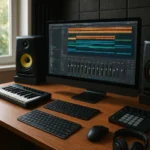
If you’re building out your DIY Recording Studio, having a dedicated “AI station” can speed up your workflow by 50%.
👉 Shop Music Production Gear on:
- MIDI Controllers: Amazon | Guitar Center | Sweetwater
- Digital Audio Workstations (DAWs): Amazon | Sweetwater
🛠️ 7 Best AI Tools for Music Generation Complementing ChatGPT
While ChatGPT handles the “brains,” these tools handle the “ears.” We recommend using them in tandem.
- Suno AI: Best for generating full songs with vocals from a text prompt.
- Udio: A fierce competitor to Suno, known for high-fidelity audio.
- AIVA: Excellent for cinematic orchestral scores.
- Sinsy: As mentioned in the OpenAI Community forums, this HMM-based system can turn ChatGPT’s MusicXML into singing voices.
- LALAL.AI: Perfect for splitting stems if you want to sample an AI-generated track.
- Orb Producer Suite: A set of plugins that use AI to create melodies and basslines directly in your DAW.
- Landr: For AI-powered mastering once your ChatGPT-inspired track is finished.
🎧 Real-Life Examples: Songs and Projects Powered by ChatGPT
Does it actually sound good? Well, beauty is in the ear of the beholder. In our featured video, the creator used ChatGPT to write a song about AI taking over the world. The result? A surprisingly coherent track where the AI even suggested the main riff and vocal melody.
The “AI Takeover” Project Breakdown:
- Lyrics: “The circuits and wires, now rule the world’s stage…” (Refined through iterative prompting).
- Chords: A dark, minor-key progression suggested by the bot.
- The Verdict: It works as a “tool in the toolbox,” not a replacement for the artist.
We’ve also seen users on Reddit and the OpenAI forums using ChatGPT to generate MusicXML for classical compositions, which are then performed by real musicians. It’s a collaborative effort between man and machine.
💡 Tips for Using ChatGPT to Enhance Your Music Creativity
Want to sound like a pro? Stop asking basic questions. Use these expert strategies:
- Ask for “Negative Constraints”: “Write a jazz progression without using any dominant 7th chords.” This forces the AI to be more creative.
- Use Musical Modes: Instead of “happy,” ask for “Lydian mode” to get that dreamy, Steve Vai-esque vibe. Check out our Instrument Tutorials to learn how to play these on your gear.
- Iterate, Don’t Settle: If the first melody is bland, tell it: “This is too stepwise. Add more leaps and syncopation.”
- The “Style Thief”: Ask it to analyze the harmonic structure of a specific artist (e.g., “What makes a Tame Impala chord progression unique?”) and then apply those rules to a new idea.
⚠️ Limitations and Challenges of Using ChatGPT for Music
It’s not all sunshine and synthesizers. There are some major hurdles:
- The “Hallucination” Factor: Sometimes ChatGPT will insist that a C Major chord contains an F#. It doesn’t. Always double-check the theory.
- Lack of “Groove”: AI is mathematically perfect, which often means it’s boring. It doesn’t know how to “swing” unless you manually adjust the MIDI velocity and timing in your DAW.
- Copyright Gray Areas: Who owns an AI-generated melody? This is a hot topic in Copyright and Licensing. Currently, the US Copyright Office has stated that AI-generated content without significant human intervention cannot be copyrighted.
- Training Data Bias: As one user noted, “It writes poems well because it has lots of that in the training data, but it doesn’t quite have a lot of high-quality music.”
🔮 The Future of AI-Generated Music: Where Does ChatGPT Lead Us?
We are standing on the edge of a “Multimodal” revolution. Soon, ChatGPT won’t just give you the instructions for a song; it will likely have an integrated audio engine. Imagine saying, “Hey, make this chorus sound more like 1970s David Bowie,” and hearing the change in real-time.
But for now, the magic happens in the collaboration. You provide the soul, the sweat, and the late-night inspiration; ChatGPT provides the structure, the theory, and the endless variations.
But wait—if the AI can write the song, and another AI can sing it, what happens to the “artist”? We’ll explore that existential dread (and how to profit from it) in the next section. 🚀
Conclusion
So, can ChatGPT generate music? The short answer: Yes and no. ChatGPT excels at generating lyrics, chord progressions, and music theory insights with impressive depth and flexibility. It’s a powerful songwriting assistant that can spark creativity, help overcome writer’s block, and provide detailed musical blueprints. However, it does not directly produce audio or fully realized music tracks on its own. Instead, it outputs text-based formats like MIDI code, MusicXML, or notation that you can then bring to life using dedicated music production software and AI audio tools.
Positives:
- Excellent at generating lyrics in various styles and moods.
- Strong grasp of music theory, modes, and chord progressions.
- Can produce structured musical data (MIDI, MusicXML) for further use.
- Highly customizable through detailed prompts.
- Works well as a collaborative creative partner.
Negatives:
- No native audio or sound output.
- Sometimes produces theoretically incorrect or generic music without careful prompting.
- Lacks the ability to capture groove, feel, and human nuance.
- Requires additional tools and technical know-how to convert text into sound.
Our expert team at Make a Song™ confidently recommends using ChatGPT as a creative catalyst rather than a standalone composer. Pair it with AI music generators like Suno AI, AIVA, or voice synthesis tools like Sinsy to unlock its full potential. If you’re ready to roll up your sleeves and experiment, ChatGPT can be a game-changer in your songwriting and music production workflow.
Remember the question we teased earlier: If AI can write and sing songs, what happens to the artist? The answer lies in collaboration—AI is a tool that amplifies your unique voice, not replaces it. Your human touch remains the heart of every great song.
Recommended Links
👉 Shop AI and Music Production Tools:
-
AIVA (Artificial Intelligence Virtual Artist):
Amazon Search: AIVA | AIVA Official Website -
Sinsy Singing Voice Synthesizer:
Sinsy Official Website -
Ableton Live (DAW):
Amazon Search: Ableton Live | Ableton Official Website -
FL Studio (DAW):
Amazon Search: FL Studio | Image-Line Official Website -
Serum by Xfer Records (VST Synth):
Amazon Search: Serum VST | Xfer Records Official Website -
MIDI Controllers:
Amazon Search: MIDI Controller | Guitar Center
Recommended Books on AI and Music:
-
Artificial Intelligence and Music Ecosystem by Eduardo Reck Miranda
Amazon Link -
Music and AI: Theory and Practice by Michael Casey
Amazon Link -
Songwriting Without Boundaries by Pat Pattison (for lyric inspiration)
Amazon Link
FAQ: Your Burning Questions About ChatGPT and Music Answered
Can ChatGPT generate sheet music?
Yes, ChatGPT can generate text-based sheet music formats such as ABC notation or MusicXML. By providing detailed prompts, it can write out melodies, chords, and arrangements in these formats, which you can then import into notation software like MuseScore or Finale. However, it does not produce graphical sheet music images directly; you need to use a dedicated program to visualize and print the notation.
Can ChatGPT generate audio?
❌ No, ChatGPT cannot generate audio files or sound directly. It outputs text, including music notation or code that can be converted into audio by other software. To hear music generated with ChatGPT’s help, you must use a DAW (Digital Audio Workstation) or AI audio tools like Suno AI or Sinsy to synthesize vocals or instruments from the text-based data.
Can you use ChatGPT for music?
✅ Absolutely! ChatGPT is a versatile tool for songwriting, lyric generation, chord progression suggestions, and music theory explanations. It’s especially useful for musicians looking to brainstorm ideas, refine lyrics, or understand complex musical concepts. For full music production, it works best when combined with other AI tools and music software.
How does ChatGPT create original music compositions?
ChatGPT creates original compositions by predicting sequences of tokens based on its training data, which includes vast amounts of text about music theory, notation, and lyrics. It can generate melodies, chords, and song structures in text form but does not “compose” music in the traditional sense of hearing and feeling sound. Its originality depends heavily on the specificity and creativity of your prompts.
Can I use ChatGPT to write lyrics for my songs?
Yes! Writing lyrics is one of ChatGPT’s strongest suits. It can generate lyrics in any style, mood, or genre you specify. You can ask for rhyme schemes, metaphors, or storytelling elements. Many songwriters use ChatGPT to overcome writer’s block or to get fresh ideas, then polish the output with their own artistic touch.
What tools work best with ChatGPT for music production?
ChatGPT pairs well with:
- DAWs like Ableton Live, FL Studio, and Logic Pro for arranging and producing music.
- AI music generators such as Suno AI and AIVA for audio creation.
- Sinsy for converting MusicXML into singing voice synthesis.
- VST plugins like Serum for sound design.
- MIDI converters and scripting languages (Python libraries like
mido) to turn ChatGPT’s code output into playable MIDI files.
Is ChatGPT capable of generating melodies and harmonies?
Yes, but with caveats. ChatGPT can generate melodies and harmonies in text formats like ABC notation or MIDI code snippets. The quality varies depending on how detailed your prompt is. It understands music theory well enough to create harmonically sound progressions, including modes and jazz chords, but the output may lack the nuance and emotional depth of human composition without iterative refinement.
Reference Links and Further Reading
- OpenAI Community Discussion: Can ChatGPT generate music?
- OpenAI Community: Using ChatGPT to make music
- AI-Pro.org: How to Use ChatGPT to Compose a Song
- Sinsy Singing Voice Synthesizer
- MuseScore Notation Software
- Ableton Live Official Website
- AIVA AI Composer
- Xfer Records Serum Synth
- Make a Song™ Lyric Inspiration Category
- Make a Song™ Melody Creation Category
- Make a Song™ DIY Recording Studio Category
- Make a Song™ Copyright and Licensing Category
Ready to start your AI-powered songwriting journey? Remember, the magic happens when you blend your creativity with the power of AI. Happy composing! 🎶