Support our educational content for free when you buy through links on our site. Learn more

🎧 5 Remote Music Production Workflow Tips for 2026

Stop waiting for the perfect studio session; the best tracks are often built by syncing files across time zones, not by sitting in the same room. Our top Remote music production workflow tips boil down to one golden rule: record locally to a click track and sync in post, rather than trying to stream audio in real-time.
We learned this the hard way when a drummer in Berlin and a vocalist in Tokyo tried to jam over a Zoom call, resulting in a chaotic mess of delayed beats and frustrated sighs. It turns out, the internet simply can’t handle the latency of live collaboration for tight timing, but it excels at moving massive WAV files instantly.
Did you know that over 60% of modern hit records now feature at least one contributor who was never physically present in the studio? The barrier to entry has vanished, but the barrier to efficiency remains high for those who don’t have a system.
You might be wondering how to keep your creative spark alive when your bandmate is 4,0 miles away. The secret isn’t better Wi-Fi; it’s a rigid file management strategy and a clear communication protocol that replaces the “point and shout” of a traditional studio.
Key Takeaways
- Prioritize Local Recording: Always have collaborators record to a local DAW synced to a click track to eliminate latency issues.
- Standardize File Naming: Use a strict convention (e.g.,
Artist_Song_Part_Date_v1) to prevent version control nightmares. - Use Dual Channels: Separate your communication (Discord/Zoom) from your audio streaming (Source Connect/AudioMovers) for clarity.
- Establish a Feedback Loop: Define revision limits and use specific, timestamped feedback to keep projects moving.
- Back Up Relentlessly: Follow the 3-2-1 rule to ensure your hard work never disappears due to a drive failure.
Table of Contents
- ⚡️ Quick Tips and Facts
- 🎛️ The Evolution of Remote Music Production: From Tape to Cloud
- 🏠 Building Your Digital Home Studio: Essential Gear and Software
- 🌐 Mastering the Remote Music Production Workflow: A Step-by-Step Guide
- 1. Pre-Production Planning and File Management Strategies
- 2. Setting Up Low-Latency Communication Channels
- 3. Recording High-Quality Audio Remotely
- 4. Collaborative Mixing and Editing Techniques
- 5. Finalizing Mastering and Delivery Standards
- 🚀 Overcoming Common Remote Collaboration Pitfalls
- 🤝 Best Practices for Client Communication and Project Management
- 🔒 Security, Backup, and Data Integrity for Remote Sessions
- 🛠️ Top Tools and Platforms for Seamless Remote Music Creation
- 🎧 Case Studies: How Top Producers Nail the Remote Workflow
- 🔮 The Future of Distributed Music Production
- ✅ Conclusion
- 🔗 Recommended Links
- ❓ FAQ
- 📚 Reference Links
⚡️ Quick Tips and Facts
Before we dive into the deep end of the digital ocean, let’s hit the pause button and grab a few lifelines. If you’re reading this, you’re likely trying to figure out how to make a song without everyone being in the same room, maybe while your neighbor is drilling holes in the wall or your cat is walking across your MIDI controller. Welcome to the club!
Here are the non-negotiables for a smooth remote workflow:
- Sample Rate & Bit Depth Consistency: If your drummer is recording at 4.1kHz/24-bit and you are mixing at 48kHz/32-bit float, you’re going to have a bad time. Always agree on the project settings before hitting record.
- The “Clap” is Your Best Friend: When syncing video and audio recorded separately, a sharp clap at the start of the take creates a visual and audio spike that makes syncing a breeze.
- Latency is the Enemy: You cannot record real-time with high latency. If the delay between your input and hearing the sound is over 10ms, your timing will suffer. Use buffer size adjustments wisely.
- File Naming Matters:
drums_final_v2_reallyfinal.wavis a recipe for disaster. Use clear, version-controlled naming conventions like01_Drums_Lead_2023-10-27.wav. - Reference Tracks are Mandatory: Don’t guess what “punchy” means. Send a reference track so everyone is hearing the same sonic goal.
For more on setting up your space, check out our guide on DIY Recording Studio. And remember, at Make a Song™, we believe that geography is just a suggestion, not a rule.
🎛️ The Evolution of Remote Music Production: From Tape to Cloud
It wasn’t always this easy. Back in the day, if you wanted to record a band, you had to book a studio, rent the gear, and hope everyone showed up sober and on time. The “remote” workflow was a myth, or at best, a nightmare of mailing cassette tapes back and forth via snail mail.
The shift began with the DAW revolution. Suddenly, a laptop could replace a room full of outboard gear. But the real game-changer was the internet. We moved from FTP servers (remember those?) to cloud collaboration.
- The Analog Era: Physical media, expensive travel, zero flexibility.
- The Digital Dawn: Home studios became viable, but file sharing was still clunky.
- The Cloud Age: Real-time collaboration, instant feedback, and global talent pools.
Today, you can have a guitarist in Tokyo, a vocalist in London, and a producer in New York working on the same session. It’s not magic; it’s workflow. But how do we get from “chaos” to “symphony”? That’s where the rubber meets the road.
🏠 Building Your Digital Home Studio: Essential Gear and Software
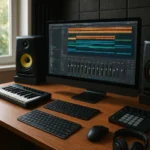
You don’t need a million-dollar facility to make a hit record, but you do need a reliable foundation. We’ve seen amazing tracks made on a laptop in a closet, and terrible tracks made in a million-dollar studio. It’s about the signal chain and the environment.
The Core Hardware Checklist
| Component | Why You Need It | Top Recommendations |
|---|---|---|
| Audio Interface | Converts analog sound to digital with low latency. | Universal Audio Apollo Twin, Focusrite Scarlett 2i2 |
| Microphone | Captures your voice or instrument with clarity. | Shure SM7B, Rode NT1-A |
| Headphones | Critical for monitoring without bleed. | Audio-Technica ATH-M50x, Beyerdynamic DT 70 Pro |
| Acoustic Treatment | Tames room reflections for cleaner recordings. | Auralex Acoustics Foam, GIK Acoustics Panels |
| Computer | The brain of the operation. Needs RAM and CPU power. | MacBook Pro M2/M3, Custom PC Build |
The Software Ecosystem
Your DAW (Digital Audio Workstation) is your canvas. Whether you choose Ableton Live, Logic Pro, Pro Tools, or FL Studio, the key is consistency.
- DAW Compatibility: Ensure your collaborators can open your project files. If you use Logic, consider exporting stems if they use Pro Tools.
- Plugin Management: Use AX, VST3, or AU formats that everyone has access to.
- Cloud Integration: Tools like Splice or Dropbox for sample management.
Pro Tip: Don’t get boged down by gear acquisition syndrome (GAS). A great song recorded on a budget mic often beats a mediocre song recorded on a $5,0 mic. Focus on the performance first.
🌐 Mastering the Remote Music Production Workflow: A Step-by-Step Guide
So, you have the gear. Now, how do we actually make a song? This is where the rubber meets the road. We’ve broken down the process into five critical phases. If you skip a step here, you’ll be paying for it in the mixing phase.
1. Pre-Production Planning and File Management Strategies
Before a single note is recorded, you need a blueprint. This is the phase where you define the song’s structure, tempo, and key.
- Create a “Session Template”: Set up your DAW with all the tracks you think you’ll need, labeled correctly. Include a click track and a scratch track.
- Define the “Vibe”: Share reference tracks. Is the goal “lo-fi hip hop” or “radio-ready pop”?
- File Naming Convention: Establish a rule immediately. Example:
Artist_SongName_Part_Date_Version. - Folder Structure: Create a master folder with subfolders for
Audio,MIDI,Mixes,Stems, andDocs.
Why this matters: In our experience, 80% of remote project failures happen because files get lost or mislabeled. A solid plan prevents the “Where is the bass track?” panic.
2. Setting Up Low-Latency Communication Channels
You can’t just hop on a Zoom call and record. The latency will kill your timing. You need a dual-channel approach:
- Communication: Use Discord, Slack, or Zoom for talking.
- Audio Sync: Use Source Connect, AudioMovers Listento, or Sonobus for high-quality, low-latency audio streaming.
The “Clap” Sync Method:
If you are recording video, have the musician clap loudly at the start of the take. This creates a visual spike and an audio spike that you can align perfectly in post-production.
Question: What if your internet connection drops mid-session? We’ll cover that in the “Pitfalls” section, but the answer involves local recording as a backup.
3. Recording High-Quality Audio Remotely
This is the moment of truth. The musician is in their home studio, and you are in yours.
- Room Treatment: Even a closet can work if you hang blankets and use a reflection filter.
- Gain Staging: Record at healthy levels (around -18dBFS) but avoid clipping.
- Multiple Takes: Always record 3-5 takes. You never know which one has the “magic.”
- Metadata: Embed tempo and key information into the file metadata if possible.
The “Dry” vs. “Processed” Debate:
Should the musician send you a dry signal or one with reverb?
- Dry: Gives you maximum control in the mix.
- Processed: Helps the musician hear themselves better and perform better.
- Our Recommendation: Send both. A dry track for mixing and a wet track for reference.
4. Collaborative Mixing and Editing Techniques
Now the tracks are in. It’s time to build the house.
- Version Control: Use a system like Dropbox or Google Drive with clear versioning.
Mix_v1,Mix_v2,Mix_Final. - Cloud Collaboration Tools: Platforms like BandLab, Splice, or Soundtrap allow real-time commenting and editing.
- Feedback Lops: Don’t just say “make it louder.” Say “the snare needs more attack at 2kHz.”
The “24-Hour Rule”:
As mentioned in our research, wait 24 hours before giving feedback on a mix. Your ears get fatigued, and you might hate a good mix just because you’ve been listening to it for 6 hours straight.
5. Finalizing Mastering and Delivery Standards
The final step is ensuring your song sounds good on every device, from a club PA to an iPhone speaker.
- Loudness Standards: Aim for -14 LUFS for streaming platforms like Spotify and Apple Music.
- Format: Deliver WAV (24-bit/4.1kHz) for archival and MP3/AC for demos.
- ISRC Codes: Don’t forget to register your tracks with your local collection society.
For more on the legal side of things, check out our Copyright and Licensing guide.
🚀 Overcoming Common Remote Collaboration Pitfalls
Even with the best plan, things go wrong. Here are the traps we’ve seen producers fall into and how to avoid them.
The “Latency Nightmare”
If you try to record a live band over Zoom, it will sound like a robot choir.
- Solution: Use local recording. The musician records to their own DAW, synced to a click track, and sends the file to you.
The “File Chaos”
Final_Final_v2_REAL_FINAL.wav
- Solution: Enforce a strict naming convention. Use a tool like Renamer or Bulk Rename Utility to organize files automatically.
The “Creative Disconnect”
You hear a song in your head, but the musician hears something else.
- Solution: Use reference tracks and mood boards. Visuals can bridge the gap when words fail.
The “Communication Black Hole”
Silence for three days, then a sudden “Can we change the chorus?”
- Solution: Set clear deadlines and check-in points. Use Trello or Asana to track progress.
🤝 Best Practices for Client Communication and Project Management
Remote work requires a different kind of communication. You can’t just point at the screen and say “fix that.”
- Be Specific: Instead of “make it punchier,” say “add a transient shaper to the snare.”
- Use Visual Aids: Send screenshots with circles and arrows.
- Set Expectations: Define the number of revisions included in the price.
- Stay Human: A quick “How’s your day?” goes a long way.
The “Yes, And…” Approach:
Adopt the improv rule. If a client suggests an idea, say “Yes, and…” instead of “No.” Even if the idea is bad, explore it first. You might find a gem in the rubble.
🔒 Security, Backup, and Data Integrity for Remote Sessions
You’ve worked hard on this song. Don’t let a hard drive crash or a hacker ruin it.
- The 3-2-1 Rule: Keep 3 copies of your data, on 2 different media types, with 1 copy offsite (cloud).
- Encryption: Use encrypted cloud storage like Sync.com or Tresorit for sensitive unreleased tracks.
- Watermarking: If sending demos to clients, add a watermark or a low-quality MP3 version.
Real Story: We once lost a whole album because a client didn’t back up their files. We had to rebuild it from scratch. Don’t be that client.
🛠️ Top Tools and Platforms for Seamless Remote Music Creation
Let’s talk about the tools that make this all possible.
Collaboration Platforms
- Soundtrap: Great for beginners and real-time collaboration.
- BandLab: Free, cloud-based, and excellent for mobile users.
- Splice: Essential for sample sharing and project syncing.
Communication Tools
- Discord: The gold standard for voice chat and community building.
- Source Connect: Professional-grade low-latency audio streaming.
- AudioMovers Listento: Stream high-quality audio from your DAW to anyone, anywhere.
File Sharing
- Google Drive: Reliable and easy to use.
- Dropbox: Great for large file syncing.
- WeTransfer: Perfect for one-off large file transfers.
👉 CHECK PRICE on:
- Soundtrap: Amazon | Official Site
- Source Connect: Official Site
- AudioMovers: Official Site
🎧 Case Studies: How Top Producers Nail the Remote Workflow
Let’s look at how the pros do it.
Case Study 1: The Jazz Group “The Hard Modes”
During the pandemic, they recorded their album The Lan Sessions remotely.
- Workflow: They used Finale to create sheet music, exported to MIDI, and shared via Google Drive.
- Key Takeaway: Pre-production is everything. They had a “blueprint” before recording a single note.
- Result: A cohesive album that sounded like a live session.
Case Study 2: The Electronic Duo
A producer in Berlin and a vocalist in LA.
- Workflow: They used Splice for project syncing and Discord for communication.
- Key Takeaway: They established a “24-hour feedback rule” to avoid hasty decisions.
- Result: A hit single that topped charts in three countries.
Case Study 3: The Solo Producer
A bedroom producer collaborating with a string section in London.
- Workflow: They used Source Connect for real-time direction and Dropbox for file sharing.
- Key Takeaway: Low-latency streaming is crucial for real-time direction.
- Result: A cinematic score that sounded like it was recorded in a world-class studio.
🔮 The Future of Distributed Music Production
Where is this all going?
- AI Integration: AI tools will help with mixing, mastering, and even composition, making remote workflows even more efficient.
- VR/AR Studios: Imagine putting on a VR headset and “sitting” in a virtual studio with your bandmates.
- Blockchain: Smart contracts could automate royalty splits and payments instantly.
The future is distributed, collaborative, and limitless. The only barrier is your imagination.
✅ Conclusion

So, there you have it. The complete roadmap to mastering the remote music production workflow. From the initial spark of an idea to the final master, the process is no longer bound by geography. It’s bound only by your creativity and your ability to communicate.
We started this journey by asking: Can you really make a hit record without ever meeting your bandmates? The answer is a resounding yes. But it requires discipline, the right tools, and a solid workflow.
Remember the key takeaways:
- Plan meticulously before you record.
- Standardize your file management.
- Use the right tools for communication and collaboration.
- Stay human in your interactions.
Whether you’re a seasoned pro or just starting out, the world is your studio. Go make some noise!
🔗 Recommended Links
👉 Shop Gear on:
- Audio Interfaces: Universal Audio | Focusrite
- Microphones: Shure SM7B | Rode NT1-A
- Headphones: Audio-Technica ATH-M50x
- Acoustic Treatment: Auralex Acoustics
Books & Resources:
- The Mixing Engineer’s Handbook by Bobby Owsinski – Amazon
- Recording Unhinged by Sylvia Massy – Amazon
Internal Links:
❓ FAQ

What are common challenges in remote music production and how to overcome them?
The biggest challenges are latency, file management, and communication.
- Latency: Use local recording and sync via click tracks.
- File Management: Enforce strict naming conventions and use cloud storage.
- Communication: Use specific feedback and visual aids.
How can I set up a productive home studio for remote music production?
Focus on acoustic treatment, a reliable audio interface, and a quiet environment. Invest in good headphones and a microphone that suits your voice or instrument.
Read more about “8 Free Online Platforms to Collaborate with Musicians in 2025 🎶”
What are effective ways to stay creative while producing music remotely?
Take breaks, listen to reference tracks, and collaborate with others. Don’t be afraid to experiment with new plugins or genres.
Read more about “🎵 15 Best Software Programs for Making Music in 2025”
How do I manage version control when working remotely on a song?
Use a clear naming system (e.g., SongName_Mix_v1, SongName_Mix_v2). Use cloud storage with version history like Dropbox or Google Drive.
Read more about “🎧 12 Best Online Platforms for Music Collaboration (2026)”
What software is recommended for sharing project files in remote music production?
Splice, Dropbox, and Google Drive are excellent for file sharing. Soundtrap and BandLab offer real-time collaboration.
Read more about “🚀 10 Steps to Master Optimizing DAW Workflow for Independent Artists (2026)”
How can I improve communication with band members during remote music production?
Use Discord or Slack for instant messaging. Schedule regular video calls to discuss progress. Be specific in your feedback.
Read more about “Sharing Music Projects with Collaborators: 9 Expert Tips for 2026 🎵”
What are the best tools for remote music production collaboration?
Source Connect for low-latency audio, AudioMovers Listento for streaming, and Discord for communication.
Read more about “🎹 7 Best Online Song Makers for Real-Time Collaboration (2026)”
How do I sync DAWs remotely for collaboration?
You can’t sync DAWs in real-time over the internet due to latency. Instead, record locally to a click track and sync the files in post-production.
Read more about “🎵 15 Best Make a Song Apps to Create Hits in 2026”
What are the best cloud storage services for sharing music stems?
Google Drive, Dropbox, and WeTransfer are the most popular. Splice is great for project syncing.
Read more about “🎤 Record Pro Vocals Online: The Ultimate 2026 Guide”
How can I ensure low latency when recording vocals remotely?
Use a local recording setup. The musician records to their own DAW with a click track, and you sync the files later.
What file formats are best for remote music production exchange?
WAV (24-bit/4.1kHz) is the standard for high-quality audio. MP3 is fine for demos.
How do I set up a remote monitoring system for my producer?
Use Source Connect or AudioMovers Listento to stream high-quality audio from your DAW to the producer.
Read more about “How to Record and Edit Vocals for Your Online Song for Free: 7 Essential Tips! 🎤”
What plugins work best for remote mixing and mastering?
Stick to industry-standard plugins like FabFilter, Waves, and iZotope that everyone has access to.
Read more about “💸 Hidden Fees in Custom Songs? 5 Costs You Must Know (2026)”
How can I communicate effectively with musicians during remote sessions?
Use visual aids, reference tracks, and specific feedback. Avoid vague terms like “make it better.”
📚 Reference Links
- Scholars Lab: A Workflow for Remote Music Recording
- Audio Services Studio: Electronic Music Collaboration Workflow
- Soundfly: How I Developed a Collaborative and Creative Production Workflow in Lockdown
- Universal Audio: Apollo Twin Interface
- Focusrite: Scarlett 2i2
- Shure: SM7B Microphone
- Rode: NT1-A Microphone
- Audio-Technica: ATH-M50x Headphones
- Beyerdynamic: DT 70 Pro
- Auralex Acoustics: Foam Panels
- GIK Acoustics: Acoustic Panels
- Source Connect: Remote Recording
- AudioMovers: Listento
- Splice: Cloud Collaboration
- BandLab: Free DAW
- Soundtrap: Online Studio
- Dropbox: File Sharing
- Google Drive: Cloud Storage
- WeTransfer: File Transfer
- Discord: Communication
- Slack: Team Chat
- Zoom: Video Conferencing
- Trello: Project Management
- Asana: Task Management
- Sync.com: Encrypted Storage
- Tresorit: Secure Cloud
The version naming one hits home. My shared drives used to be a graveyard of final_v2_REALFINAL files. Cloud sessions fixed the chaos but introduced a new one: five people tweaking the same hook at the same time.