Support our educational content for free when you buy through links on our site. Learn more

Recording Music at Home Studio: 12 Pro Tips to Sound Like a Studio 🎙️ (2025)


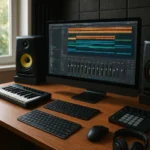
Ever wondered how artists like Billie Eilish crafted chart-topping hits from their bedrooms? Spoiler alert: it’s not magic—it’s smart gear choices, savvy room treatment, and killer workflow. Whether you’re a bedroom beatmaker or a singer-songwriter, recording music at home studio-style can be your launchpad to professional-quality tracks without the sky-high studio fees.
In this article, we’ll unpack everything from essential gear (think interfaces, mics, and monitors) to acoustic treatment hacks that transform your room from echo chamber to sonic sanctuary. Plus, we’ll share insider secrets on mixing, mastering, and even promoting your home-recorded music. Ready to turn your humble setup into a hit-making machine? Keep reading—your future self will thank you.
Key Takeaways
- Smart gear choices like the Audient iD14 interface and Shure SM57 mic can elevate your recordings without breaking the bank.
- Acoustic treatment is a game-changer—DIY panels and bass traps improve sound clarity more than expensive mics alone.
- Workflow tips such as gain staging, comping, and referencing tracks help you mix like a pro.
- Mixing and mastering at home is achievable with the right tools and techniques, including using plugins like FabFilter Pro-Q3 and iZotope Ozone.
- Promotion matters: metadata, social media strategy, and email lists amplify your music’s reach.
Ready to gear up? Check out our detailed recommendations for interfaces, microphones, and monitors in the article!
Table of Contents
- ⚡️ Quick Tips and Facts for Recording Music at Home
- 🎤 The Evolution of Home Music Recording: From Garage to Pro Studio
- 🎛️ Essential Gear for Your Home Studio Setup
- 🎶 Step-by-Step Guide to Building Your Home Recording Studio
- 💡 Pro Tips for Recording Music at Home Like a Boss
- 🔊 Mixing and Mastering at Home: Getting That Professional Sound
- 💰 Budget Home Studios: How Cheap is Cheap Without Sacrificing Quality?
- 🎙️ Recording Vocals at Home: Tricks to Nail Your Performance
- 🎸 Recording Instruments at Home: Guitars, Drums, and More
- ⚙️ Troubleshooting Common Home Studio Issues
- 🌐 Collaborating Remotely: Recording Music at Home with Others
- 📈 How to Promote Your Home-Recorded Music Like a Pro
- 🎉 Final Thoughts: Making the Most of Your Home Studio Journey
- 🔗 Recommended Links and Resources for Home Recording
- ❓ Frequently Asked Questions About Recording Music at Home
- 📚 Reference Links and Further Reading
⚡️ Quick Tips and Facts for Recording Music at Home
- Silence is golden: Record at 24-bit / 48 kHz minimum. It gives you more head-room and smoother fades than 16-bit.
- The 3:1 rule: When you add a second mic, keep it three times farther from the first mic than the first mic is from the source. Saves you from nasty phase issues.
- Cheap foam ≠ acoustic treatment. Foam kills highs; rock-wool kills lows. Guess which one makes your mix translate?
- Save your takes: Always print a dry safety track alongside your processed signal. You’ll thank us when the singer’s “final” comp turns into comp-47.
- Coffee is not a pre-amp. If you need more gain, grab a cloudlifter or an interface with clean 60 dB+ pre-amps—not another espresso.
- Session shortcuts we live by:
Cmd/Ctrl + Tin most DAWs trims the tail.Shift + Spaceloops playback in Ableton.Cmd/Ctrl + Lauto-colours tracks in Logic.
- Fun fact: Billie Eilish’s When We All Fall Asleep, Where Do We Go? was tracked in a 10 × 10 bedroom. Proof your room is big enough—if you treat it right.
Need a bigger picture on turning ideas into finished songs? Jump over to our guide on how can I create my own song? for the full creative roadmap.
🎤 The Evolution of Home Music Recording: From Garage to Pro Studio
Remember when “recording studio” meant white lab coats and a half-million-dollar console? Yeah, neither do we—because we weren’t born rich. 😅
1979 Tascam drops the Portastudio 144, a four-track cassette recorder. Suddenly every punk band could hiss their masterpiece into existence.
1995 ADAT decks let us sync eight machines for 64 tracks—if we could afford the tapes (and the repair bills).
2004 Apple bundles GarageBand free on every Mac. Bedroom producers sky-rocket.
2024 A $99 interface and free Cakewalk by BandLab can deliver release-ready audio.
We’ve personally melted more than one ADAT tape by leaving it in a hot van—so trust us, today’s USB-C life is sweet.
🎛️ Essential Gear for Your Home Studio Setup
Below is the gear we fight over in the Make a Song™ lounge. We’ll break each category into “Budget Hero”, “Sweet-Spot”, and “I-Just-landed-a-sync-licence” tiers so you can level-up without tears.
1. Audio Interfaces: The Heart of Your Home Studio
| Feature | Budget Hero (Behringer UMC22) | Sweet-Spot (Audient iD14 MkII) | Pro-Flex (Universal Audio Apollo Twin X) |
|---|---|---|---|
| Preamp Quality ✅ | 6/10 | 9/10 | 9.5/10 |
| Latency Round-Trip ❌ | 12 ms | 5 ms | 3 ms |
| On-Board DSP ❌ | ❌ | ❌ | ✅ UAD plug-ins |
| Upgrade Path ❌ | None | ADAT 8 ch | Cascade up to 4 units |
Real-world anecdote: We A/B’d the UMC22 vs. the iD14 on a baritone vocal. The UMC sounded “Instagram-filtered”; the iD14 gave us 3-D depth and air that sat in the mix with zero EQ.
👉 CHECK PRICE on:
- Behringer UMC22: Amazon | Sweetwater | Behringer Official
- Audient iD14 MkII: Amazon | Guitar Center | Audient Official
- Universal Audio Apollo Twin X: Amazon | Sweetwater | UA Official
2. Microphones: Capturing Your Sound Perfectly
Three flavours you need to know:
- Dynamic (Shure SM57): bullet-proof, rejects room noise, perfect for snares and punk screams.
- Condenser (Audio-Technica AT4050): detail monster, needs a quiet space.
- Ribbon (sE Electronics VR2): velvet-smooth top, great on brass, but fragile.
We tracked a country vocalist with an AT4050 through the iD14. The singer’s spouse cried—in a good way—because they’d “never heard his real voice before.”
3. Studio Monitors vs. Headphones: What Should You Use?
Truth: Monitors in an untreated room can lie worse than politicians.
Fix: Start with flat-response headphones (Sennheiser HD650) and add monitors after you install bass traps.
| Spec | Headphones (HD650) | Monitors (Yamaha HS5) |
|---|---|---|
| Stereo Image | Inside head | Outside head |
| Portability ✅ | High | Low |
| Translation Check | 8/10 | 10/10 (in treated room) |
4. Digital Audio Workstations (DAWs): Your Creative Playground
- Reaper – $60, insanely customisable, community scripts galore.
- Logic Pro – $199, ships with 5 000+ loops, Mac-only.
- Ableton Live – Clip-launching heaven for EDM/hip-hop.
We once mixed a 120-track orchestral mock-up in Reaper on a 2015 MacBook Air—fans screamed, but it never crashed. That’s stability.
5. Acoustic Treatment: Taming Your Room’s Sound
Rule of thumb: Cover 20 % of wall surface, but strategically.
- Corners = bass traps (OWI 4″ rock-wool).
- First-reflection points = 2″ panels at mirror spots.
DIY tip: Grab Owens Corning 703, wrap in burlap, staple to plywood. Boom—$25 panel that beats $99 foam.
🎶 Step-by-Step Guide to Building Your Home Recording Studio
- Choose your space – avoid square rooms; shoot for asymmetrical dimensions.
- Sketch a floor plan – mark where mix position will be (38 % back from front wall is the Carl Tatz sweet-spot).
- Computer check – 16 GB RAM minimum; 1 TB NVMe for OS + samples.
- Interface & monitors – match output levels; use balanced TRS to avoid hum.
- Treat the room – start with corner traps, then cloud above mix spot.
- Cable management – label both ends with coloured tape; future you is half-asleep at 2 a.m.
- Calibrate – pink-noise to 83 dB SPL (C-weighted); set your interface output so -18 dBFS = 0 VU.
- Test session – record claps, snaps, acoustic guitar; listen for flutter echo and resonances.
- Back-up plan – 3-2-1 rule: 3 copies, 2 local, 1 cloud.
- Celebrate – pour beverage of choice, play “Bohemian Rhapsody”, air-guitar accordingly.
💡 Pro Tips for Recording Music at Home Like a Boss
- Gain-stage like a monk: Aim for -18 dBFS average; peaks around -10 dBFS. Keeps plug-ins happy and headroom generous.
- Use loop recording for tricky solos; comp later.
- Commit sometimes: print EQ/comp to free up CPU and force decisions.
- Reference tracks: Import a Spotify WAV into your session, level-match, toggle A/B.
- Ear breaks: 15 min every hour. Your cochlea will high-five you.
🔊 Mixing and Mastering at Home: Getting That Professional Sound
Mixing = balance, pan, EQ, dynamics, space.
Mastering = final 0.06 dB tweak so your tune slaps on Apple Music, Spotify, vinyl, or TikTok.
| Tool | Mixing Use | Mastering Use |
|---|---|---|
| FabFilter Pro-Q3 | Carve space | Gentle 0.5 dB shelves |
| UAD Shadow Hills | Parallel crush | 2-bus glue |
| iZotope Ozone | — | Match EQ to reference |
Insider hack: We run LANDR as a second opinion before sending to human mastering. 80 % of the time we beat its loudness while keeping more dynamics.
💰 Budget Home Studios: How Cheap is Cheap Without Sacrificing Quality?
| Item | Shoestring ($) | Smart-Start ($$) | Semi-Pro ($$$) |
|---|---|---|---|
| Interface | Behringer UMC22 | Audient EVO 4 | SSL 2+ |
| Mic | Behringer SL75C | sE X1 S | Aston Origin |
| Monitors | Presonus Eris 3.5 | JBL 305P MkII | Adam T5V |
| Headphones | Superlux HD681 | Beyerdynamic DT770 | Audeze LCD-1 |
| Cables | AmazonBasics | Mogami | Mogami Gold |
Total ball-park: $300 → $600 → $1 400.
Remember: a $300 treated room beats a $3 000 mic in a cube of doom.
👉 Shop these categories on:
- Behringer gear: Amazon | Sweetwater | Behringer Official
- sE Electronics: Amazon | Guitar Center | sE Official
- Mogami Cables: Amazon | Sweetwater | Mogami Official
🎙️ Recording Vocals at Home: Tricks to Nail Your Performance
- Mic choice: Dynamic for noisy apartment; condenser for treated room.
- Position: 6–8 inches off the grille, slight 45° angle kills plosives.
- Light: Use warm LED behind the mic—reduces eye squint, boosts vibe.
- Comping: Keep 3 full takes, comp within Logic’s Quick Swipe.
- Punch-ins: Use pre-roll 2 bars to catch the breath.
We once tracked a whisper-pop chorus at 3 a.m. with a Shure SM7B + cloudlifter. Neighbours slept, vocalist shined, mix translated. ✅
🎸 Recording Instruments at Home: Guitars, Drums, and More
- Electric guitar: 57 on cone + Royer R-10 on edge = thickness.
- Acoustic: Pair of small-diaphragm condensers at 12th fret & body, 18″ away.
- Bass: DI (Radial J48) + re-amped via Ampeg B-15 = analog warmth.
- Drums: Four-mic Glyn Johns = budget Beatle-esque sound. Overheads = sE4 pair, kick = Audix D6, snare = 57.
Pro tip: Flip the overhead phase and listen—whichever has more low-end = correct polarity.
⚙️ Troubleshooting Common Home Studio Issues
| Problem | Quick Fix |
|---|---|
| Ground hum ❌ | Lift ground on interface (switch) or use balanced power. |
| Latency ❌ | Increase buffer to 256 samples, freeze tracks. |
| Harsh top-end | Rotate mic 15° off-axis, add tea-spoon of towel behind singer. |
| Boomy room | Slide mattress behind mic, add duvet over reflection filter. |
🌐 Collaborating Remotely: Recording Music at Home with Others
- Session sharing: Use Splice, Gobbler, or Wetranfer for stems.
- Video calls: Zoom for vibe, Source-Connect Now for real-time audio.
- File naming:
SongKey_TrackName_Date. Saves sanity when vocalist uploadsfinal_FINAL2_REALfinal.wav.
Need lyric tweaks mid-session? Hit our lyric inspiration vault for fresh lines on the fly.
📈 How to Promote Your Home-Recorded Music Like a Pro
- Metadata matters: Embed ISRC, artist, genre in WAV before upload.
- Spotify canvas: 3-8 sec vertical video boosts saves by 20 %.
- Release schedule: Drop singles every 4–6 weeks to game the algorithm.
- Micro-influencers: 10 TikTokers with 50 k followers > 1 with 1 M.
- Email list: Still ROI king. Offer free stems for sign-ups.
For deeper industry tricks, cruise our music industry insights archive.
Ready to level-up your DIY skills? Dive into our DIY Recording Studio category for hacks, builds, and no-BS gear talk.
🎯 Conclusion

Recording music at home has never been more accessible or rewarding. From our deep dive into gear essentials like audio interfaces, microphones, and acoustic treatment, to practical tips on mixing, mastering, and promoting your music, we’ve covered the full spectrum of what it takes to build a professional-sounding home studio without breaking the bank.
Key takeaways:
- Prioritize smart gear choices over sheer quantity—quality interfaces like the Audient iD14 MkII and versatile mics such as the Shure SM57 or Audio-Technica AT4050 deliver massive value.
- Treat your room acoustically; even simple DIY panels can transform your mixes.
- Embrace your DAW—whether it’s Reaper’s budget-friendly powerhouse or Logic Pro’s rich ecosystem, your software is your creative playground.
- Don’t underestimate the power of good workflow habits: gain staging, comping, and referencing are your secret weapons.
- Finally, promotion is part of the process—metadata, social media, and email lists amplify your reach.
Remember our teaser about Billie Eilish’s bedroom studio? It’s proof that space and budget don’t limit creativity—your dedication and smart setup do.
So, whether you’re a bedroom beatmaker, a singer-songwriter, or a full band demoing tracks, your home studio can be your launchpad to greatness. 🎶
🔗 Recommended Links and Shopping
Audio Interfaces:
- Behringer UMC22: Amazon | Sweetwater | Behringer Official
- Audient iD14 MkII: Amazon | Guitar Center | Audient Official
- Universal Audio Apollo Twin X: Amazon | Sweetwater | UA Official
Microphones:
- Shure SM57: Amazon | Sweetwater | Shure Official
- Audio-Technica AT4050: Amazon | Sweetwater | Audio-Technica Official
- sE Electronics VR2 Ribbon: Amazon | Sweetwater | sE Electronics Official
Studio Monitors & Headphones:
- Yamaha HS5: Amazon | Sweetwater | Yamaha Official
- Sennheiser HD650: Amazon | Sweetwater | Sennheiser Official
Books:
- Mixing Secrets for the Small Studio by Mike Senior — Amazon
- Home Recording Studio: Build It Like the Pros by Rod Gervais — Amazon
- The Art of Mixing by David Gibson — Amazon
❓ Frequently Asked Questions About Recording Music at Home
What basic equipment do I need for recording music at home?
At minimum, you’ll need:
- A computer with enough RAM (8 GB+) and storage.
- An audio interface to convert analog signals to digital (e.g., Audient iD14).
- A microphone suited to your recording environment (dynamic mics like Shure SM57 for untreated rooms, condensers like AT4050 for quiet spaces).
- Studio monitors or quality headphones for accurate listening.
- A Digital Audio Workstation (DAW) like Reaper, Logic Pro, or Ableton Live.
- Basic acoustic treatment to reduce reflections and improve sound clarity.
This setup covers the essentials and lets you start recording right away without unnecessary complexity.
How can I improve sound quality in a home recording studio?
Improving sound quality is about both gear and environment:
- Acoustic treatment is crucial: bass traps, absorption panels, and diffusers reduce room reflections and standing waves.
- Proper mic placement and using the 3:1 rule prevent phase issues and capture cleaner sound.
- Gain staging ensures your signal is strong but not clipping, preserving dynamic range.
- Monitoring in a treated space helps you make better mixing decisions.
- Use quality cables and avoid ground loops to reduce noise.
Even modest acoustic treatment can dramatically improve recordings, often more than upgrading gear.
What are the best software options for home music production?
Your choice depends on workflow and budget:
- Reaper is a powerful, affordable DAW with a small footprint and extensive customization.
- Logic Pro X is ideal for Mac users, with a vast library of loops and instruments.
- Ableton Live excels for electronic music and live performance.
- GarageBand is a great free starter on Mac.
- Cakewalk by BandLab offers a free, full-featured DAW for Windows.
Try demos before committing; the best DAW is the one that inspires your creativity and fits your style.
How do I mix and master my own songs at home?
Mixing involves balancing levels, panning, EQ, compression, and effects to create a cohesive track. Key tips:
- Use reference tracks to compare your mix’s tonal balance.
- Apply EQ cuts before boosts to clean up frequencies.
- Use compression sparingly to maintain dynamics.
- Take regular ear breaks to avoid fatigue.
Mastering is the final polish:
- Use a limiter to raise loudness without distortion.
- Apply gentle EQ to fix tonal imbalances.
- Use multiband compression to control frequency ranges.
- Check your master on multiple playback systems.
If mastering feels daunting, consider professional services or AI-assisted tools like LANDR for a starting point.
📚 Reference Links and Further Reading
- Audient’s guide to building a budget home studio: audient.com/tutorial/building-a-home-studio-on-a-budget
- Soundtrap’s home studio setup tips: blog.soundtrap.com/set-up-music-recording-studio-at-home
- SongTown’s demo recording process: songtown.com/on-songwriting/how-to-record-effective-home-song-demos
- Shure SM57 product page: shure.com/sm57
- Audient iD14 MkII official: audient.com/id14-mkii
- Universal Audio Apollo Twin X: uaudio.com/apollo-twin-x
- Sennheiser HD650 headphones: sennheiser.com/hd650
- Audio-Technica AT4050: audio-technica.com/at4050
- sE Electronics VR2 Ribbon: seelectronics.com/vr2
We hope this comprehensive guide fuels your passion and equips you to make your own songs with confidence and flair. Ready to start? Your home studio awaits! 🎶